
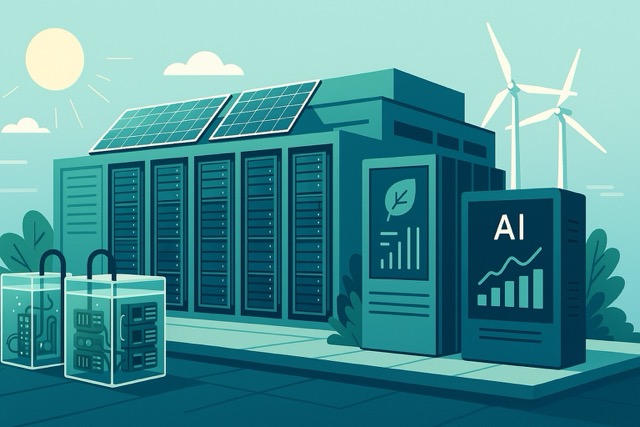
If you’re running or managing a data center, you already know how much energy your infrastructure consumes—and how quickly costs can spiral. With power demands rising due to AI workloads and cloud services, reducing environmental impact isn’t just a corporate responsibility anymore—it’s a business advantage. In this article, you’ll explore five high-impact innovations that help you cut costs, meet sustainability goals, and future-proof your facility without sacrificing performance.
1. Immersion Cooling: Efficient Heat Management Without Fans
You can eliminate a large portion of your cooling overhead with immersion cooling. This method involves submerging servers in a thermally conductive dielectric fluid that transfers heat away from the components much faster than traditional air cooling systems. By removing the need for high-speed fans and large-scale air conditioning, you reduce both noise and electricity use.
This isn’t just a futuristic concept. Enterprises like Meta and Alibaba have already deployed immersion-cooled server clusters to handle AI training and large-scale processing with improved efficiency. According to recent benchmarks, immersion cooling can cut energy consumption by up to 30% compared to traditional setups. That translates directly into lower power bills and less hardware wear from thermal cycling, which also saves you money on maintenance and replacements.
2. Renewable Energy Integration: Powering Up with Sun and Wind
The demand for electricity in hyperscale data centers is putting serious strain on power grids—and driving up operating expenses. If you’re not already integrating renewable energy into your setup, now’s the time. Companies like Google, Amazon, and Microsoft are investing in direct power purchase agreements (PPAs) with solar and wind farms to offset their carbon footprint and stabilize energy costs.
You don’t need a billion-dollar budget to follow that lead. Many co-location and regional data centers are turning to on-site solar arrays and partnering with utilities to access cleaner energy at fixed rates. Even a partial shift to renewables can lower your reliance on fossil fuels and offer long-term pricing stability, which is especially valuable in areas with unpredictable grid rates. It’s not just a sustainability checkbox—it’s a strategic move to keep your margins healthy.
3. AI-Powered Energy Management: Smarter Efficiency in Real Time
Artificial intelligence isn’t just changing how you process data—it’s changing how you manage your infrastructure. By using machine learning algorithms to monitor temperature, server load, airflow, and power consumption, you can predict spikes in activity and adjust systems automatically. This real-time optimization slashes unnecessary energy use while maintaining peak performance levels.
Google’s DeepMind is a proven case. It helped reduce their data center cooling costs by 40% by using AI to anticipate and respond to changes faster than any human could. For your operation, AI can handle workload distribution, shut down idle hardware, or adjust cooling strategies on the fly—all without manual intervention. That efficiency directly boosts your bottom line and lowers your environmental impact without compromising uptime.
4. Modular Data Centers: Scalable and Efficient by Design
Traditional data centers often face an efficiency problem: they’re too big for their initial workload and use energy inefficiently as they scale up. A modular data center solves this issue by letting you deploy only what you need—when you need it. These pre-engineered units are built off-site and delivered fully equipped, ready for rapid deployment with minimal on-site construction.
If your business model includes unpredictable growth or regional expansion, modular builds let you stay lean while scaling up. You get better airflow control, tailored power systems, and tighter thermal zones, which all contribute to lower PUE (Power Usage Effectiveness) ratings. Companies with edge computing needs are especially benefiting from this approach because it allows you to maintain efficiency while getting closer to end users.
5. Waste Heat Reuse: Turning Heat Into a Revenue Stream
Every server you run generates heat, and most facilities simply vent it into the atmosphere. But you can capture and repurpose that heat to reduce utility bills or even sell it to nearby buildings. Heat reuse systems transfer warm air or water from your servers to heating grids, water heaters, or greenhouses.
This isn’t theory—it’s being done now. In Switzerland, the Swiss Federal Institute of Technology (ETH Zurich) uses waste heat from their Aquasar supercomputer to warm campus buildings. Closer to home, several data centers in Northern Europe are feeding their waste heat into city heating networks. By doing this, you’re not just reducing your cooling load; you’re turning a liability into an asset.
Top Green Innovations in Data Centers
- Immersion cooling cuts energy use by up to 30%
- Solar and wind power reduce reliance on fossil fuels
- AI optimizes real-time energy consumption
- Modular builds scale efficiently with lower PUE
- Heat reuse turns waste into value
Why Going Green Pays Off Now
Green technology isn’t a marketing gimmick anymore—it’s a necessity. When you invest in energy efficiency and sustainability, you reduce operating costs, attract ESG-focused investors, and build resilience against rising energy prices. Each of these five innovations not only saves money but also positions your data center as a forward-thinking, cost-effective operation in a highly competitive space. With increasing pressure from regulators and clients alike, staying ahead of energy efficiency standards isn’t optional—it’s a competitive edge you can’t afford to ignore.
Eager to explore more insights on sustainable technology, infrastructure management, and business innovation? You can find additional resources and information on my Weebly.

Barry Bekkedam is an entrepreneur and finance executive focused on investment management and advisory. A former Villanova standout and member of Canada’s men’s national basketball team, he now leads ventures in asset management and philanthropy, including the Barry Bekkedam Foundation supporting education and community development.