
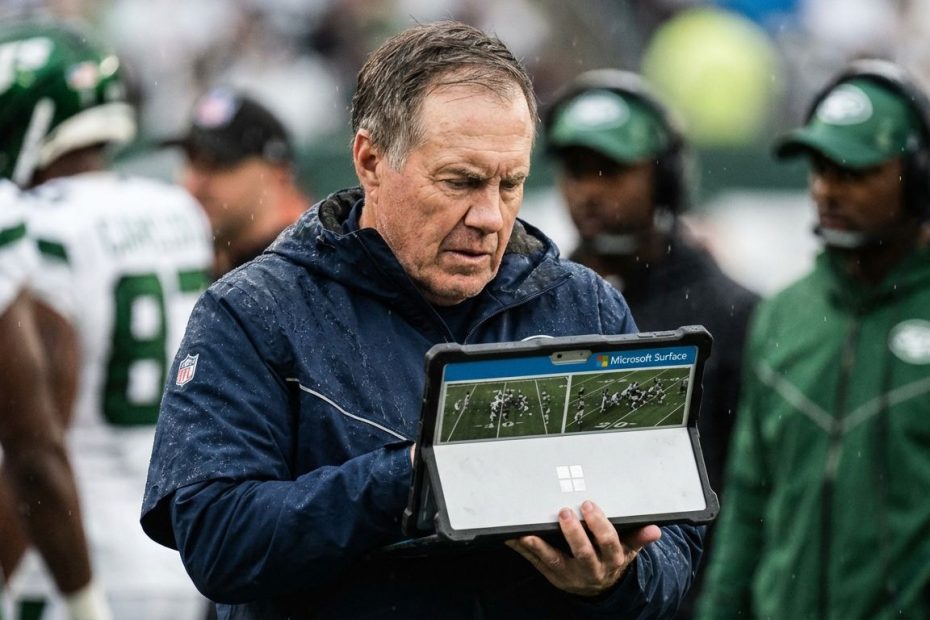
You’re watching an NFL sideline shift from paper playbooks and printed photos to a controlled, league-managed tech stack: Microsoft Surface tablets for rapid still-image review, helmet radios with a strict cutoff, and newer AI features that speed up sorting and surfacing the right plays.
This guide walks you through what’s actually on those screens, what the rules allow, why restrictions exist, what changed in 2025–2026 with AI-enabled filtering, and how teams protect reliability when the tech fails. You’ll also get a clean view of what’s banned on the sideline, plus how NFL-style communication is influencing football below the pro level.
How Do NFL Teams Use Tablets On The Sideline And What Are They Actually Allowed To Show?
On game day, the tablet is best understood as a tightly controlled viewing terminal, not an open “device” in the consumer sense. You’re seeing Microsoft Surface units distributed to coaches and players to review what just happened, quickly, with consistent formatting and league oversight. The workflow is built around speed, clarity, and standardization, so everyone is looking at the same category of material in the same way.
Historically, the center of the tablet experience has been still images from the just-completed series, organized so a coach can jump to a situation and confirm alignment, spacing, leverage, or assignment errors. That matters because the sideline window is short, and the coaching point needs to land in seconds. When the tablet is used correctly, you’re not “watching film,” you’re validating a specific detail, then turning it into an adjustment the next drive can execute.
You also need to separate what the broadcast makes you assume from what a staff actually does. Players flipping through screens is not a guarantee they’re reviewing the same thing you are on TV, or that they’re gaining access to the same angles you see in a replay package. The league designs these systems to keep the process consistent across all 32 teams, reduce ad-hoc workarounds, and limit competitive gray areas that used to show up when every club built its own sideline setup.
The practical coaching win is clean, fast confirmation. A quarterback can verify a safety rotation look. A receiver can confirm whether a corner is playing off or pressing and what the cushion really looks like. A line coach can show a tackle the exact hand placement issue that keeps losing the edge. That’s why the tablet replaced paper, it compresses the time between mistake and correction.
What Do Players Look At On The Tablets During A Game?
When you see players on the bench swiping and tapping, the content is usually tied to immediate, fixable problems. You’re looking at still shots that let a player confirm where eyes were, where feet were, and whether the defense presented the look that was expected. This is less about entertainment, more about clearing up the argument that always happens after a play: “I thought you were here,” “I expected you to be there,” “I didn’t see that rotation.”
The images become a shared truth source for the coaching point. A coordinator can point at leverage on a key third down and explain why the route depth must change. A defensive coach can show a linebacker how far a back actually widened and why the fit broke. You don’t waste the next series debating memory. You correct it and move on.
From an operational standpoint, the tablet also keeps the sideline organized. Instead of stacks of printed photos being carried, sorted, and re-sorted, the content is indexed and accessible without a staffer sprinting through binders. That reduces sideline clutter, reduces time lost, and reduces the chance that someone grabs the wrong sequence of shots during a high-tempo stretch.
It also changes how you coach different personality types. Some players respond to one sentence and a shove back toward the field. Others need to see it to believe it, and the tablet closes that loop fast. When the staff uses the device with discipline, the tablet becomes a coaching accelerator, not a distraction.
Why Cant NFL Coaches Just Watch Video Replays On The Sideline Tablets?
The NFL has treated sideline video access as a competitive boundary, and the early era of sideline tablets was explicitly framed around still photos rather than unrestricted video. The reason is simple: if a staff can scrub video like a film room between snaps, you change how quickly teams can self-scout, counter-adjust, and exploit tendencies midgame. That compresses preparation advantage into live-play reaction time.
This is also about standardization and enforcement. A tablet that runs one controlled workflow is easier to monitor than a tablet that could run any app, connect to any service, or accept any file. You can run a clean operation when the league dictates what is allowed, what is logged, and what the devices can do. That reduces disputes, reduces suspicion, and reduces the temptation to build “creative” pipelines that the other team can’t see.
Another reason is pace and focus. Video invites endless debate, pausing, rewinding, arguing over frames, arguing over whether a receiver got contacted early, and burning time that should go to the next call. Still images push the staff toward what matters most between drives: alignment, technique, and assignment. The league’s limits force coaching discipline.
From a veteran operations view, the bigger point is that the sideline is not the building. Coaches still have booth workflows, staff communication chains, and structured processes for review decisions. The tablet is one piece of a wider system, and the rule limits keep it from becoming the only piece.
Whats New In 2025 To 2026 Are Teams Using AI On The Sideline Now?
Yes, the publicly described shift for the 2025 season was not just “better tablets,” it was AI-enabled filtering that speeds up how a staff finds relevant plays. Under the expanded NFL–Microsoft partnership, the league upgraded more than 2,500 sideline Surface tablets and added an AI feature that filters in-game plays by criteria like down-and-distance, scoring plays, and penalties. The operational impact is that coaches spend less time hunting and more time coaching.
The most important part to understand is what the AI is doing and what it is not doing. The league messaging describes AI as a way to expedite analysis and reduce friction in accessing the right items, not as a tool that replaces coaching decisions. That matters because staffs do not need a machine telling them what call to run. They need the correct slice of evidence presented fast enough to matter before the next drive starts.
The same reporting also described hardware and connectivity upgrades, including 5G-capable Surface Pro 11 devices with AI chips, plus Surface laptops for coaches in the booth with similar capabilities. That points to a broader shift in sideline tech priorities: retrieval speed, usability for football staffers, and consistent access under real stadium conditions. When these systems work, you get faster confirmation of tendencies and faster delivery of corrections.
You should expect AI features to keep focusing on sorting, tagging, and retrieval. That’s where seconds matter and where human attention is limited. The staff that wins the usability battle wins more time for actual football, and that is the only metric that matters on Sunday.
How Do Coach To Player Helmet Headsets Work And When Do They Shut Off?
If you want one rule detail that explains half of what you see pre-snap, it’s the cutoff. The NFL’s coach-to-player helmet communication begins once an official signals the down is over, and it is cut off when the play clock hits 15 seconds or when the ball is snapped, whichever happens first. That is why you see quarterbacks break the huddle and still manage checks without a coach talking in their ear all the way to the snap.
The system is limited by design. Each team is allowed no more than one player on the field on offense and one on defense with a helmet speaker, and there are limits on how many active radio receivers can be available at a time. That forces teams to designate primary and backup users and manage substitutions cleanly. Operational sloppiness creates penalties, confusion, and wasted time, so teams build routine around this.
From a coaching workflow view, the headset window is for clarity and speed, not micromanagement. You communicate the play, confirm the tempo, confirm the formation, and set the alert. Once the cutoff hits, the quarterback and defensive signal caller must own the final adjustments. That’s why veteran quarterbacks still matter, and why defenses still lean on communication structure and repetition.
The cutoff also changes how you script situational football. Two-minute tempo, backed up calls, red-zone sequences, and third-down packages have to be communicated cleanly before the 15-second threshold. A staff that can’t operate inside that timing rule will look slow and disjointed, regardless of talent.
Are Smartwatches Phones Or Other Personal Devices Allowed On NFL Sidelines?
The sideline is not a bring-your-own-device environment. The league has emphasized enforcement against unauthorized electronic devices, and teams know this is an area where compliance matters because it ties directly to competitive integrity and communication controls. When a device is not standardized and not monitored, it creates the possibility of hidden messaging, unlogged information transfer, or unapproved capture of game material.
That’s why teams invest in approved systems and keep everything else out of the bench area workflows. League-issued tablets, league-governed communications, and defined exceptions are the norm. If a staff member starts freelancing with personal tech, that becomes a risk to the club, not a clever advantage.
From an operational discipline standpoint, it also helps the staff. When you remove personal devices, you reduce distraction and eliminate the “quick check” culture that creeps in under pressure. The sideline should be a production environment, and production environments run best when the tool set is tight and consistent.
You also get cleaner accountability. When everyone uses the same approved systems, you can audit issues, correct process problems, and train new staffers faster. That shows up in fewer communication breakdowns, fewer wasted series, and fewer avoidable penalties tied to administrative errors.
What Happens If The Sideline Tablets Fail Have There Been Real Outages?
Yes, outages have happened, and they matter because midgame reliability is not optional. One widely reported example came during the AFC Championship game on January 24, 2016, when the Patriots had trouble accessing still photos on the sideline tablets for a stretch. Reporting included a Microsoft statement that the issue was network-related, not a tablet hardware failure, and that the problem lasted about 20 minutes.
The bigger lesson is that the device is only as good as the infrastructure around it. Stadium environments are brutal: wireless congestion, physical cabling risks, weather, sideline traffic, and constant movement. You’re also operating under time pressure where a two-drive gap in access can change how quickly you correct a defensive fit problem or confirm a coverage tendency.
That’s why teams keep contingency workflows. You prepare printed materials, establish fallback communication routines, and train staffers to operate without the screen. A staff that panics when the tablet goes dark is a staff that loses focus on the actual job, which is calling and executing the next play.
From a technology operations view, reliability planning is as important as the feature set. You can deploy the most advanced sorting and filtering in the world, and it won’t matter if connectivity breaks at the wrong time. The teams that treat sideline tech like mission-critical equipment, not a gadget, gain consistency over the course of a season.
Is The NFL Influencing College And High School Football With Sideline Tech And Helmet Comms?
Yes, and the adoption pattern is easy to track: once a communication method becomes normal at the top level, everyone below starts pushing for it, often accelerated by competitive controversies and pressure to modernize. College football’s move toward coach-to-player helmet communication is a clear example. It aligns with the general pro model of limiting who receives communication and enforcing a cutoff that prevents coaching through the snap.
This trickle-down also affects how younger quarterbacks are developed. When athletes grow up with structured helmet communication, they learn tempo, command, and terminology earlier. That can improve execution, yet it also raises the bar for staff organization at lower levels, where budgets and staffing are tighter and game management is often less standardized.
High school football is also seeing growth in wearable and play-calling technologies, with governing bodies weighing competitive equity and cost. When these tools are introduced, the early advantage tends to go to programs that implement strict process: who programs the calls, who audits them, how the cadence is managed, and how you handle failure midgame.
If the goal is cleaner football, the tech can help, but only when paired with operational discipline. Sloppy technology use creates confusion faster than it creates speed. You get better results when you treat these tools as part of a system, with training, rules, and accountability built in.
How Does NFL Sideline Technology Work During Games?
- Tablets: show league-controlled still images for fast corrections
- No live video: limits midgame self-scouting advantages
- AI upgrades (2025–26): faster play sorting by situation
- Helmet radios: coach-to-player audio cuts off at 15 seconds
- Strict rules: only approved devices allowed on sidelines
Bring The Sideline Into The Modern Era Without Losing Control
The NFL sideline has turned into a managed technology environment where speed, control, and reliability outrank novelty. Tablets replaced paper to deliver immediate still-image coaching, helmet radios deliver play calls until the 15-second cutoff, and the newest upgrades push AI toward faster retrieval rather than automated decision-making. You also see why personal devices stay out and why outages still matter, the infrastructure is part of the product. If you want to understand Sunday football at a higher level, track how teams manage time between series, how they communicate before the cutoff, and how they use tech to reduce friction without creating distraction. That’s where modern sideline advantage shows up, not in flashy screens, but in faster corrections and cleaner execution.

Barry Bekkedam is an entrepreneur and finance executive focused on investment management and advisory. A former Villanova standout and member of Canada’s men’s national basketball team, he now leads ventures in asset management and philanthropy, including the Barry Bekkedam Foundation supporting education and community development.