
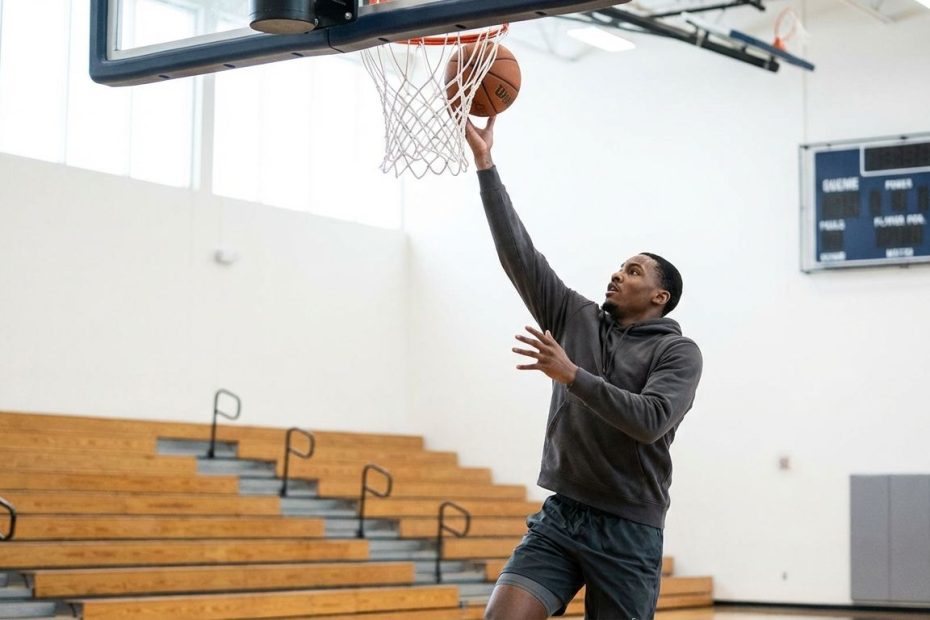
You break a shooting slump by shrinking the shot back to high-confidence range, rebuilding clean mechanics with a tight routine, then re-loading game-speed reps with clear shot-selection rules.
This article gives you five proven techniques that work for real players: a close-range reset, makes-based ladders, a one-variable mechanical fix, a pressure-proof pre-shot routine, and quiet-eye style focus to control attention under stress. You’ll also get game-time adjustments, fatigue-proof practice design, and a simple way to track whether the slump is mechanics, decision-making, or mental noise.
1. Reset Your Mechanics With Close-Range Form Shooting
When your jumper feels “off,” the fastest correction rarely starts at the three-point line. You rebuild your shot from the rim outward because close-range reps expose the truth: balance, release path, and clean finish. From a few feet away, you can’t hide behind power, and you can’t blame the miss on range. The ball tells you immediately whether the release is straight and whether the guide hand is behaving.
Run a reset block that is short, strict, and repeatable. Start directly in front of the rim, shoot one-hand form shots or light two-hand set shots, and demand a clean finish with full extension and relaxed follow-through. Track makes, but grade every rep on process: stacked elbow, stable base, quiet guide hand, and a consistent finish. When the ball starts coming off your fingers the same way every time, the “slump” stops feeling mysterious and starts feeling fixable.
Stay close until you earn the right to move back. A useful rule is “three clean makes in a row before stepping back,” because it forces discipline and keeps you from chasing. Move from front-of-rim to slight angles, then short corner and wings, then midrange, then threes. You’re rebuilding a chain, not hunting a lucky make.
- Set length: 8–12 minutes
- Target: 40–60 makes total
- Non-negotiables: balanced feet, relaxed shoulders, high finish held for one second
2. Use Makes-Based Ladders To Rebuild Confidence Without Reinforcing Bad Reps
Volume without structure is how slumps get extended. When you miss and respond by firing more random shots, you train tension, rushed rhythm, and bad selection. A makes-based ladder flips the incentive: you advance only after you hit your make goal. That creates fast wins, restores trust, and prevents the “spray and pray” session that leaves you frustrated and tired.
Build your ladder around the shots that matter for your role. If you’re a catch-and-shoot wing, prioritize corner threes, wing threes, and free throws. If you’re a guard who lives on pull-ups, prioritize one-dribble pull-ups, free throws, and relocation threes. Keep the ladder tight enough that you can complete it in one workout, and strict enough that it forces focus when your mind starts wandering.
Run the ladder for one to three sessions, then switch back to normal training. The goal isn’t to live in “comfort mode.” The goal is to restore a stable release and rhythm, then reintroduce stress the right way. Slumps break faster when your training rewards precision, not just effort.
- Level 1: 10 makes from 3–6 feet (mixed angles)
- Level 2: 10 makes short midrange (one spot, then rotate)
- Level 3: 10 free throws (same routine every rep)
- Level 4: 15 makes from your top two three-point spots
- Rule: miss two in a row, step one level down for five makes
3. Fix One Variable, Not Your Entire Jumpshot
Players rarely slump because ten things broke at once. The slump usually starts with one small change: feet turned a few degrees, release drifting, guide hand thumb flicking, shoulders tensing, or a quicker dip that ruins timing. Then the player tries to “solve” it by changing everything, and the shot loses identity. Your job is to identify one break point and hammer it until it holds under speed.
Pick one cue per session, and make it a cue you can execute under pressure. “Elbow in” often fails because it’s vague and can create stiffness. “Finish high,” “snap to the front rim,” “hold the follow-through,” or “land in the same spot” stays usable when the gym is loud and your legs are heavy. Train that cue close to the rim first, then step out, then add movement.
Use video as a checkpoint, not a rabbit hole. Film ten shots from the side and ten from the front, then look for one obvious difference versus your best version: release height, guide hand, base width, or drift. Fix that one item for a week before touching anything else. Consistency returns when your brain stops negotiating mid-shot.
- Session cue examples: “land straight,” “eyes locked,” “hold finish,” “quiet guide hand,” “same dip every time”
- What to avoid: stacking five cues and thinking through all of them on the catch
4. Lock In A Repeatable Pre-Shot Routine That Survives Pressure
Slumps get worse in games because the routine disappears. You hesitate, adjust mid-motion, or speed up your release to “make it happen.” A routine eliminates that drift. It gives you the same breath, the same eyes, the same timing, and the same finish whether the last shot was a swish or a miss.
Keep the routine short enough to use every time. Two dribbles, breath, eyes to a specific aim point, shoot. On a catch-and-shoot, it becomes: show hands, catch, dip, up. The routine is not a show, it’s a switch. When that switch flips, your attention goes to one target and one cue, and everything else gets filtered out.
Train the routine under light pressure before expecting it to hold in a game. Set a consequence that matters: if you miss two free throws in a row, run a quick down-and-back and restart the set. If you miss a “must-make” corner three, drop back to midrange for five makes before returning. Pressure-proof habits come from reps that demand discipline, not pep talks.
- Free throw routine (simple): two dribbles, inhale, eyes on front rim, smooth release, hold finish
- Catch-and-shoot routine (simple): feet set on the hop, dip once, shoot on the same rhythm
- Decision rule: open on balance, shoot, off-balance or late closeout, drive or swing
5. Use Quiet-Eye Focus And Breathing To Stop Overthinking
A slump is often an attention problem disguised as a mechanics problem. Anxiety pulls your eyes off the target early, your breathing gets shallow, and your hands tighten. Your shot starts feeling “clunky” because your body is bracing. You don’t need a motivational speech, you need stable attention and a calm release under real speed.
Quiet-eye style focus is simple to implement on court: pick a single aim point and keep your gaze steady through the release. Pair that with one controlled breath that slows your body down enough to let timing return. The goal is not to stare harder. The goal is to remove the frantic eye movement that shows up when you’re worried about missing.
Build a short “focus block” into every workout. Shoot 20 reps where the only score kept is whether you held your gaze and held your finish. Then shoot 20 reps at game speed with the same rule. When you train attention the same way you train footwork, you stop treating the mental side like a mystery and start treating it like a skill.
- Focus block: 20 shots, grade 1–5 on gaze stability, not makes
- Breath rule: one inhale before the rep, exhale through release
- Aim point: choose one, front rim or back rim, keep it consistent for the set
How Do You Get Out Of A Basketball Shooting Slump Fast?
You get out fast by cutting range, cleaning the release, and stacking quick wins that rebuild trust. Start every workout with 8–12 minutes at the rim and short range, then move into a makes-based ladder. That combination restores touch and rhythm without letting you rehearse frustration. Fast improvement comes from controlled reps, not emotional reps.
Control what gets measured. Track makes from close range, free throws, and your top two game spots. If you want a simple metric, record how many shots it takes to reach 50 makes from your main range band. When that number drops over three sessions, the slump is already breaking, even if a scrimmage still feels rough.
Keep game shots clean while you recover. Open shots, in rhythm, with your routine, stay green-lit. Forced shots, rushed pull-ups, and late-clock heaves get replaced by rim pressure, cuts, and paint touches. You don’t protect your confidence by hiding, you protect it by taking shots you’d want again.
Why Does Your Jumpshot Suddenly Feel Awkward Even When It Used To Be Consistent?
The shot feels awkward when timing changes. That change can come from fatigue, a small footwork shift, extra tension in the shoulders, or trying to guide the ball. When timing is off, you start searching for the release instead of letting it happen. The search creates more tension, and the tension creates more misses.
Most players also change their shot during competition without noticing. You rush because a defender is closing, you drift because your base is unstable, or you lean because your legs are tired. Then practice turns into “fixing” what happened in a game rather than reinforcing your best rep. The awkward feeling is often your body telling you the rep no longer matches your default mechanics.
Correct it by returning to your anchors. Pick your base rule, your release rule, and your finish rule. Base: land straight and stable. Release: ball path stays consistent and guide hand stays quiet. Finish: wrist snaps clean and follow-through stays held. When those three anchor points are stable, the “awkward” feeling fades because the rep becomes predictable again.
What Is The Best Warm-Up To Reset Your Shot Before Practice Or Games?
The best warm-up is short-range makes plus your routine, then a controlled step-back to game range. Warm-ups fail when they jump straight into deep threes and contested pull-ups. That turns the first five minutes into proof that you’re still missing, and it spikes tension. A reset warm-up starts with touch and alignment, then adds speed.
Open with close-range form makes from three angles, then add bank shots to rebuild feel, then free throws with a locked routine. After that, hit your two favorite spots at game rhythm. Keep the warm-up makes-based, not time-based. When you require makes, you build certainty before the first live possession.
Finish warm-up with two game-speed actions you actually use. Catch-and-shoot into a relocation, one-dribble pull-up into a free throw, or cut to the rim into a corner three. That sequence bridges mechanics to decision-making. You step into competition already feeling the timing you plan to use.
- Warm-up (quick): 20 close-range makes, 10 bank makes, 10 free throws, 10 makes from top two spots
- Rule: no deep shots until short-range makes feel clean
What Should You Do In Games When Your Jumper Isn’t Falling?
You stay aggressive without getting reckless. Keep shooting open looks that match your role and your routine, and stop chasing “make-up” shots. The worst in-game pattern is passing up a good look, then taking a harder one two possessions later because frustration builds. You win the mental battle by staying consistent with your decisions.
Shift the offense toward easier scoring actions early. Get a paint touch, cut hard, set a screen, sprint to space in transition, and hunt free throws. Those plays stabilize rhythm and put points on the board without relying on a jumper. Once your body settles, the shot tends to return because you’re no longer shooting with urgency.
Use a simple rule for the next three shot opportunities: if the catch is clean and your feet are under you, shoot. If you catch off-balance, drive or swing instantly. That protects your shot profile and keeps your team flowing. A slump becomes manageable when shot quality stays high, even on a cold night.
- Early-game plan: one rim attack, one cut, one paint touch before hunting deep jumpers
- Catch rule: 0.5-second decision, shoot, drive, or swing
- Confidence builder: get to the free throw line and lock in the routine
Does Fatigue And Stress Make You Miss More, And How Should Practice Change?
Fatigue and stress reduce consistency in timing, lift, and attention. When your legs fade, your shot often flattens or drifts, and you start recruiting the upper body to create power. When stress climbs, your breathing shortens and your eyes get jumpy, which disrupts aim and release stability. Missing late in runs isn’t always a broken jumper, it’s a broken rep under load.
Practice needs separation: mechanics work when fresh, then fatigue work later. If you blend everything into one long, tired session, you often train compensations. Build a fresh block where every rep matches your best form, then add a fatigue block where the goal is to keep the routine and gaze stable while tired. That trains performance, not excuses.
Also measure whether the slump is tied to conditioning. Record your percentage on a set of 25 threes when fresh, then repeat the same set after a hard sprint sequence. If the drop is massive, conditioning and recovery deserve attention, plus tighter shot selection late in games. When the data points to fatigue, the fix becomes practical and fast.
- Fresh block: 50–80 quality makes, close range to midrange to free throws
- Fatigue block: 30–50 game-speed shots after sprints or full-court actions
- Tracking: fresh vs tired percentages on the same shot map
How Do You Know If It’s Mechanics, Shot Selection, Or A Mental Spiral?
You diagnose the slump by separating environments. If you miss in games but shoot well in calm workouts, the issue leans toward decision-making, speed of release, and attention under pressure. If you miss everywhere, including close range, mechanics and tension are leading suspects. If you make shots early then collapse late, fatigue and routine breakdown become the likely causes.
Use three quick checks. Check one: close-range form shots, do they come off clean and straight. Check two: free throws with a locked routine, do you feel rushed or calm. Check three: your top game spot, can you hit ten makes with consistent footwork. Those checks take 10–15 minutes and usually reveal where the slump lives.
Then match the fix to the diagnosis. Mechanics issues get Technique 1 and Technique 3. Shot selection issues get Technique 2 and a strict in-game decision rule. Mental spiral issues get Technique 4 and Technique 5 with pressure exposure. When the fix matches the problem, progress shows up quickly and stays.
- Mechanics signal: misses left-right, inconsistent arc, guide hand influence
- Selection signal: heavy contested jumpers, off-balance pull-ups, late-clock heaves
- Mental signal: hesitation, changed rhythm, eyes leaving the target early
How Do You Build A 7-Day Shooting Slump Escape Plan That Actually Works?
A seven-day plan works when it stays consistent and measurable. You don’t need a new workout every day, you need repeated blocks that rebuild certainty. Run the same opening reset, the same makes-based ladder, and the same routine work daily, then add a small dose of game-speed stress. That structure trains your nervous system to expect a clean rep again.
Days 1–3 focus on mechanics and confidence. Start at the rim, move to midrange, lock in free throws, and finish with your two best three-point spots. Keep volume moderate and stop the session while reps still look good. Ending on clean reps matters more than grinding until you’re tired and sloppy.
Days 4–7 reintroduce pressure. Add timed sets, sprint-to-shot sequences, contested reads, and must-make finishes. Keep the one-variable cue and the routine non-negotiable. If your shot breaks under stress, drop back a step, earn makes, then return to speed.
- Daily base plan (45–70 minutes): 10 minutes close-range reset, 20–30 minutes ladder, 10 minutes free throws, 10–20 minutes game-speed actions
- Must-measure: total makes, free throw percentage, top-spot three percentage
- Non-negotiable: one cue, one aim point, one routine
How Do You Get Out Of A Shooting Slump Fast?
- Shoot close-range form makes first, then step out
- Use makes-based ladders, no random volume
- Keep one mechanical cue, lock a routine
- Control breathing, eyes stay on one aim point
Turn Missed Shots Into A Repeatable Bounce-Back Plan
A shooting slump ends when your training becomes strict, your routine becomes automatic, and your shot selection stays disciplined. Start every session by rebuilding touch close to the rim, then stack makes-based progressions that reward clean reps. Keep one mechanical cue, use the same pre-shot routine, and train attention with steady eyes and controlled breathing. In games, stay aggressive with good looks, add paint touches early, and let the routine carry the night. Put the seven-day plan on the calendar, track the numbers, and the slump turns into a short phase you manage, not a label you wear.

Barry Bekkedam is an entrepreneur and finance executive focused on investment management and advisory. A former Villanova standout and member of Canada’s men’s national basketball team, he now leads ventures in asset management and philanthropy, including the Barry Bekkedam Foundation supporting education and community development.