
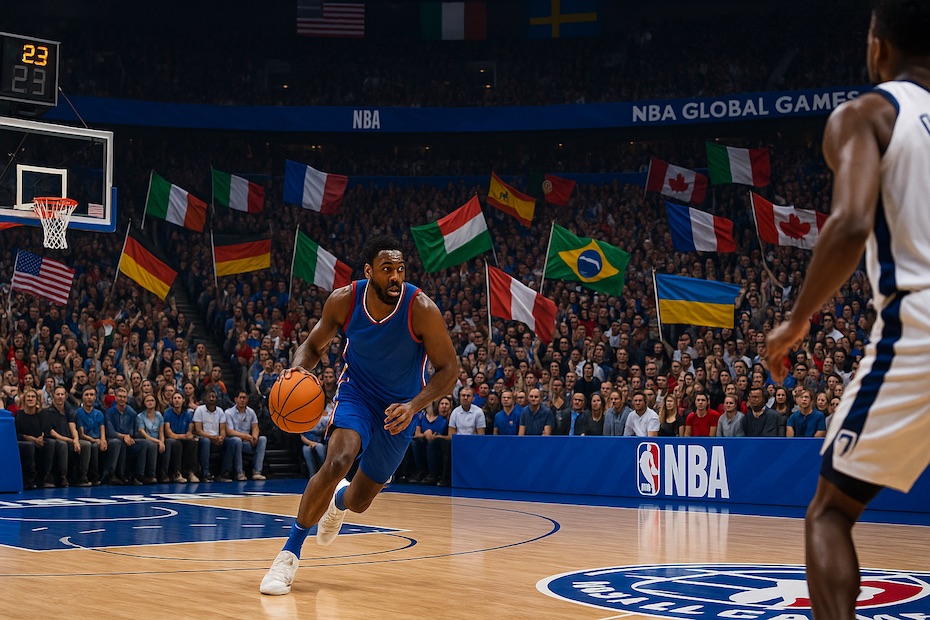
Basketball’s global growth refers to the strategic expansion of the NBA into international markets through games, media, player development, and commercial partnerships. This strategy has transformed the league from a North American product into a dominant global sports brand.
You’re no longer watching a domestic league—you’re witnessing a global enterprise. The NBA has used targeted initiatives to tap into overseas audiences, talent pools, and emerging markets. From European games to academies in Africa, this expansion is changing how the game is played, consumed, and monetized around the world. In this article, you’ll explore how the NBA is executing this strategy and what it means for you as an executive, athlete, marketer, or fan.
What’s Driving the NBA’s International Push?
The league’s international expansion is powered by a deliberate mix of global games, digital reach, grassroots programs, and multilingual content. The NBA doesn’t just sell tickets abroad—it builds infrastructure. By hosting regular-season matchups in cities like Paris and Mexico City, you gain real-time access to new fans who would otherwise only engage through highlights. These events create commercial value through licensing, merchandise, and sponsorship while leaving a lasting imprint on local sports ecosystems.
This isn’t just about entertainment—it’s about acquisition. By positioning games as cultural moments, you increase global fan conversion. Add in international media deals and the strategy becomes a business case rather than a branding experiment.
How Popular Is the NBA Internationally?
Over 75% of the NBA’s total social media following is now international. The league tallied over 26 billion video views in one recent season—most of them outside the U.S. In China alone, NBA games are streamed by hundreds of millions on Tencent and Weibo. In Europe and the Middle East, digital reach surpassed one billion views across platforms in a single year.
League Pass subscriptions have seen year-over-year growth internationally, particularly in India, the Philippines, and Brazil. If you’re looking at global retention metrics, fan stickiness is stronger in many of these markets than in traditional American cities. You’re not managing a national brand anymore—you’re growing a digital-first, international franchise.
Who Are the Most Influential Global NBA Players?
You’ve seen firsthand how players like Giannis Antetokounmpo, Nikola Jokić, and Luka Dončić have become international household names. Giannis moved jersey sales in Greece and parts of Africa, while Luka’s Slovenian popularity pushed European viewership and merchandise. France’s Victor Wembanyama sparked a major spike in youth basketball registration and viewership across Europe before ever stepping on an NBA court.
These athletes aren’t just All-Stars—they’re revenue drivers and cultural ambassadors. They build market credibility, drive sponsorships, and expand media coverage beyond U.S. borders. Your strategy should include player-centric storytelling tailored to global regions.
How Is Localized Content Fueling Growth?
The NBA has made a conscious pivot to producing content in regional languages across Instagram, TikTok, YouTube, and even WhatsApp. In India, basketball memes and reels with local commentary are outpacing generic highlight reels in engagement. In the Middle East, Arabic-language NBA content is now averaging millions of monthly interactions.
Localized content bridges cultural and linguistic gaps. It turns your broadcast into a conversation and your brand into a community. If you’re managing a global campaign, translating content isn’t enough. You need to adapt tone, humor, and relevance to fit local contexts.
What Is the Role of NBA Academies?
NBA Academies in Senegal, Australia, Mexico, and India are key to growing future talent—and by extension, fan bases. These programs identify and train young prospects while aligning them with NBA standards and media exposure. They create talent pipelines that serve both the league and its partners.
This strategy helps you scale talent development without relying solely on the NCAA system or G League. And it has proven results—NBA draftees now regularly come from academy programs. These centers also host tournaments and community events, making them touchpoints for local development and international scouting.
Is the NBA Really Launching NBA Europe?
Conversations are actively underway between the NBA and FIBA to introduce a European league with 16 teams based in cities like Paris, London, Rome, and Berlin. This model would mirror the NBA’s franchise system or possibly integrate promotion and relegation structures.
The business logic is simple. You’re seeing U.S. revenue plateau while global demand accelerates. A permanent European presence would unlock sponsorships, government partnerships, and year-round media deals in one of the world’s wealthiest sports markets. It also opens doors for cross-branding with football clubs and tech ventures rooted in European capitals.
How Do Sponsorships and Revenue Reflect Global Reach?
Roughly 15% of the NBA’s $10 billion annual revenue now comes from international markets—and that percentage is climbing fast. International sponsorships (e.g., Rakuten in Japan, Tissot in Switzerland) are becoming central to your global monetization model. Digital activations, influencer partnerships, and e-commerce channels are bringing in new income streams that wouldn’t have existed in a purely domestic model.
You’re not just selling courtside ads anymore. You’re building omni-channel ecosystems that touch fans through digital content, gaming, retail, and event experiences. The league’s partnership with Alibaba to integrate shopping with game highlights is a signal of what’s to come.
Are Fans Overseas as Loyal?
The answer is yes—and in some cases, more so. International fans tend to follow individual players and team brands with intense digital loyalty. Their consumption habits are multi-platform and highly engaged. Many fans wake up at 3 a.m. to stream live games and participate in live chats.
Your fan engagement strategy must acknowledge these superfans. Mobile-first content, real-time interaction, and exclusive drops are tools you can use to reinforce that connection. Loyalty overseas isn’t a secondary asset—it’s foundational to your next phase of growth.
NBA’s Global Growth Highlights
- 75%+ of NBA followers are international
- NBA Europe in development with 16 teams
- NBA Academies in Africa, Australia, India, and Mexico
- Localized content surpassed 1 billion views in EMEA
- Stars like Wembanyama and Giannis drive massive international traffic
In Conclusion
If you’re working in or around the NBA, you can’t afford to think locally. The league’s global expansion isn’t speculative—it’s methodical and revenue-backed. You’re entering a new phase where international cities become major market centers, overseas fans drive digital success, and global players fuel business outcomes. This is basketball’s worldwide era, and you’re in the middle of it.
The NBA’s global growth demonstrates how visionary strategy meets cultural impact—a principle that extends beyond sports. For insights on scaling ventures internationally while maintaining core values, explore leadership frameworks at Barry Bekkedam.

Barry Bekkedam is an entrepreneur and finance executive focused on investment management and advisory. A former Villanova standout and member of Canada’s men’s national basketball team, he now leads ventures in asset management and philanthropy, including the Barry Bekkedam Foundation supporting education and community development.