
Grassroots innovation is what happens when you stop waiting for perfect institutions and start building workable systems with the people already on the ground. You get faster feedback, lower overhead, and solutions that fit real daily constraints like time, trust, transport, language access, and maintenance.
This guide gives you five proven community project models you can study, fund, replicate, or improve without turning them into slow-moving programs. You’ll leave with clear operational patterns, common failure points to prevent, practical metrics to track, and a set of next actions you can take to move from inspiration to execution.
What Is “Grassroots Innovation,” And How Is It Different From A Normal Nonprofit Program?
Grassroots innovation is a bottom-up solution built with community members, shaped by local priorities, and adjusted quickly based on what works in real conditions. You’re not just delivering a service; you’re building a community-owned method that keeps functioning when budgets shrink, rules shift, or attention moves on.
Traditional programs often start with a predefined model and then recruit community participation to fit that model. Grassroots innovation reverses that order: you start with the constraint on the street, then design the smallest system that solves it, then grow only after the system proves it can stay maintained.
From a governance angle, the difference shows up in who gets to decide tradeoffs. A formal organization may optimize for reporting, compliance, and predictable outputs. A grassroots project optimizes for local usefulness, speed, and trust, even when it means operating with simpler tools and more volunteer-driven logistics.
If you want a practical definition that holds up in the real world, treat grassroots innovation as a solution that is locally initiated or co-led, solves a repeated pain point, can be replicated with modest resources, and produces trackable outcomes. When you manage it that way, you can compare very different projects on consistent standards without watering down what makes them community-led.
What Are The Best Real Examples Of Community Projects Tackling Big Problems That You Can Point To Right Now?
Five strong models show up repeatedly because they solve urgent problems with systems people can run locally: community fridges for food access, youth climate microgrants that create many small experiments, resident-led climate grants in public housing, community clean air programs that link monitoring to mitigation, and living coastal infrastructure that protects shorelines while restoring habitat.
These projects work as real operations, not just campaigns. They rely on repeatable routines, basic governance, lightweight funding, and a clear “owner” for maintenance. That’s why they scale through replication, not through one central organization trying to control every site.
You can also cite them without stretching credibility. They’re anchored in public announcements, local government programs, established nonprofits, and community networks that publish updates, award lists, and implementation details. That matters if you’re writing, fundraising, pitching, or building partnerships and need sources that hold up to scrutiny.
Use the five projects below as a playbook. Each one tackles a “big problem” with a mechanism that is easy to understand, hard to fake, and measurable enough to improve over time.
How Do Community Fridges Actually Work, And What Problems Do People Run Into?
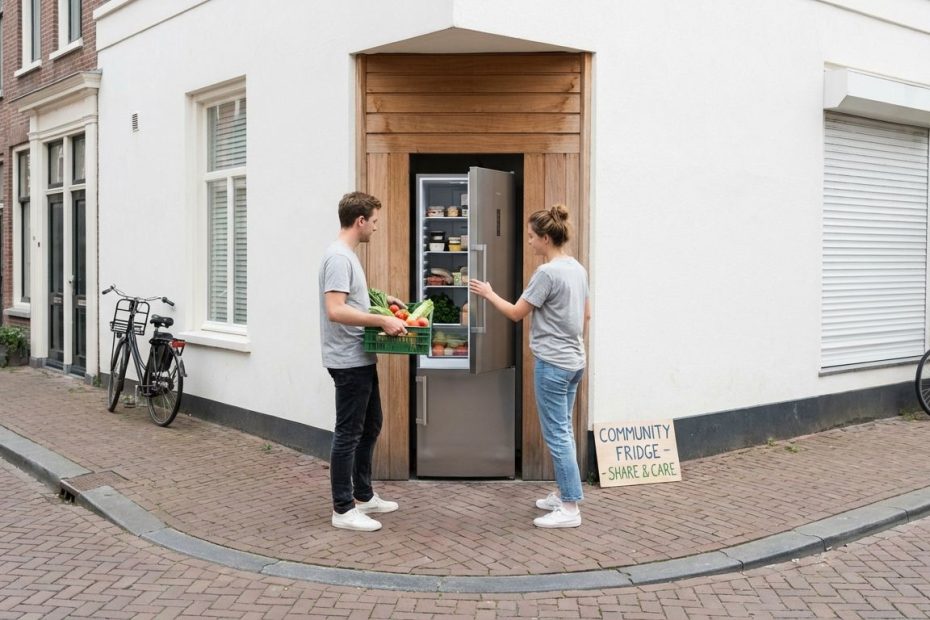
A community fridge is a publicly accessible refrigerator, often paired with a pantry, where neighbors share food with minimal friction. You’re creating a local distribution point that reduces food waste and improves access, with no appointment, no paperwork, and no gatekeeping.
The operational reality is simple and demanding at the same time. The fridge needs a host site, electricity, a cleaning routine, signage that sets expectations, and a steady flow of safe donations. If you skip the routine, the project doesn’t fail dramatically, it fails quietly through spoilage, mess, neighbor complaints, or volunteer burnout.
The most common issues raised in community discussions are practical: how long items can sit, what is acceptable to donate, how to label, how to prevent a fridge from becoming a trash magnet, and how to handle conflicts without turning the project into a policing exercise. These are not side details; they are the job.
When you want a performance-oriented way to run a fridge, manage it like a small operations team. Assign weekly ownership, track cleanings, set donation standards, and keep a simple escalation path with the host site. If the fridge is outdoors, you also plan for weather exposure, pests, and vandalism risk, then decide whether the location still makes sense.
Mutual aid networks show what “good” looks like when systems are maintained and volumes are real. Mutual Aid LA Network reports large-scale food distribution and routine support for multiple fridges, paired with rescued meals that would have been discarded. That’s a sign of logistics maturity: recurring supply, predictable cadence, clear roles, and a system that keeps moving even when any one volunteer is unavailable.
Local reporting shows how these fridges often launch: one community group finds a site, builds volunteer coverage, adds bilingual messaging, and frames the fridge as a community asset rather than a charity line. That positioning protects the project because neighbors defend what they feel ownership over.
Are There Legit Grants For Grassroots Climate Projects, And How Much Money Do They Really Provide?
Yes, grants for grassroots climate work are real, and the funding range is wider than many people expect. You’ll see microgrants designed to fund fast local experiments, and you’ll also see larger public health and environmental justice grants that support equipment, staffing, and sustained engagement.
Microgrants are valuable because they create volume. One city can fund many small, youth-led projects at once, producing a pipeline of tested ideas rather than betting everything on a single large initiative. Madison’s Youth Climate Fund model, with multiple youth-led awards, is a clean example of how to seed community-led implementation without burying applicants in bureaucracy.
Larger grants tend to show up where exposure reduction and measurable risk intersect, especially around air quality in buildings where people spend most of their time. Boston’s Community Clean Air Grant program shows how cities back community organizations with meaningful budgets tied to monitoring, mitigation, and education, rather than funding awareness-only work that produces few measurable exposure improvements.
If you manage or advise these projects, the main execution rule is to align the budget with maintenance, not just launch. Sensors, filters, compost systems, raised beds, tool libraries, and signage all degrade over time. A funding plan that ignores replacement cycles creates short-lived wins and long-term disappointment.
Grant success also depends on documentation discipline. You don’t need complex reporting, you need consistent reporting. Track installs completed, households reached, volunteer hours, events run, equipment maintenance logs, and the specific barriers you removed. That documentation makes renewal easier and creates a replication kit other neighborhoods can use.
What’s A Good Example Of Residents In Public Housing Leading Climate Projects, Not Just Being “Served”?
Resident-led climate grants in public housing are one of the cleanest signals that grassroots climate action is shifting from “outreach” to “ownership.” When residents design and lead projects, the solutions reflect building realities, daily routines, and what neighbors will actually adopt.
NYCHA’s Resident Climate Action Grants provide a visible example: multiple resident-led projects are selected and funded, with winners publicly listed and framed as resident-driven climate action. This is a different operating model from a top-down retrofit, because the “design authority” lives closer to the daily problems.
If you’ve worked in housing, you already know why this matters. A well-intended solution fails when it ignores maintenance capacity, ignores cultural norms, clashes with building rules, or requires residents to change behavior without giving them tools. Resident-led design reduces that mismatch and increases the odds of sustained use.
To run a resident-led program well, you tighten three things: decision rights, support, and guardrails. Residents need real control over project choices, access to technical support to avoid preventable mistakes, and clear rules for safety, procurement, and building compatibility. Done right, the results are practical improvements residents keep running after the grant cycle ends.
Programs that publish clear application processes and timelines also help residents plan, recruit teammates, and build realistic scopes. That predictability turns “grant chasing” into a real project pipeline.
How Are Communities Tackling Air Pollution Locally Without Waiting For National Policy?
Communities reduce air pollution exposure locally by linking three moves into one operating loop: measure air quality, mitigate it in the spaces people use, then train people to keep the gains. When you separate those moves, projects stall at awareness or data collection and never reach sustained exposure reduction.
Boston’s Community Clean Air Grant program illustrates a city-backed version of this loop. Recipients are positioned to combine indoor air quality monitoring with mitigation tools and education, so residents and community spaces can act on what the measurements show. This matters because indoor exposure is often where people can change conditions fastest, even when outdoor sources are harder to control.
You’ll see practical mitigation choices across community programs: portable air cleaners, upgraded filtration where HVAC allows it, maintenance training, and clear guidance on placement, runtime, and filter replacement. The unglamorous work is what protects outcomes. A purifier that isn’t maintained becomes an expensive box that signals progress without delivering it.
If you’re building a local clean air effort, manage it with operations metrics, not marketing metrics. Track devices deployed, filter replacement compliance, hours of operation in target spaces, and the number of people trained to keep devices running. Tie outreach to actions completed, not just attendance.
The smartest air projects also respect trust and language access. If your materials aren’t readable and culturally usable, equipment won’t be adopted consistently. Programs that include bilingual education and youth leadership can tighten compliance because households follow guidance they understand and feel proud to own.
What’s An Example Of “Living Infrastructure” That Protects Communities And Restores Nature At The Same Time?
Living infrastructure uses ecological systems as part of the protective design, so the project reduces risk and strengthens habitat rather than replacing nature with only hard barriers. You’re building protection that can improve over time instead of protection that only degrades.
Living Breakwaters on Staten Island is a well-known example of this direction: an offshore breakwater system designed to reduce coastal risk while supporting habitat and education. The project is often discussed as “blue-green” infrastructure because it combines engineered shoreline protection goals with marine ecosystem restoration and community stewardship.
From an execution standpoint, living infrastructure forces better coordination. You manage permitting, engineering, habitat monitoring, community education, and long-term stewardship as one connected effort. When any one part is treated as optional, the whole system underperforms, either ecologically, socially, or in risk reduction.
Monitoring updates tied to restoration activity, including eelgrass-related work discussed by regional environmental organizations, show why this model is operationally different from a one-time build. You plan for ongoing measurement and adaptive maintenance, which is a better match for coastlines that change and storms that test assumptions.
If you’re selecting projects to fund, living infrastructure earns serious consideration when it does three things at once: reduces risk to people, rebuilds habitat services like water quality support and shoreline stability, and trains local stewards who can keep the system watched and maintained. That combination protects investment value over the long run.
What Is A Grassroots Innovation Project?
- Locally initiated or co-led
- Solves a repeated daily problem
- Runs with modest resources
- Has simple metrics, maintenance, and replication steps
Build One System, Then Replicate It
If you want grassroots innovation to last, manage it like a system you can hand to the next team without losing quality. Pick one problem with daily urgency, choose a model with proven mechanics, then lock the maintenance plan before you chase growth. Measure outputs that reflect real use, food moved safely, filters replaced on time, projects completed on budget, residents trained to operate what got installed. Once the system runs smoothly in one place, replication becomes a logistics task rather than a reinvention effort. Keep your standards clear, your routines simple, and your ownership visible, then you’ll build projects neighbors defend and partners fund.
References
- Grassroots innovation (Wikipedia)
- AP News: Mutual aid groups and neighbor-to-neighbor support
- Community fridge (Wikipedia)
- Reddit: How to Start a Community Fridge or Free Pantry
- Mutual Aid LA Network: Year-end update
- KAWC: Yuma community fridge coverage
- City of Madison: Youth Climate Fund projects
- NYCHA Journal: Resident Climate Action Grant winners
- Public Housing Community Fund: Resident Climate Action Grants
- Boston.gov: Community Clean Air Grant recipients
- Boston.gov PDF: Community Clean Air Grant FAQ
- Billion Oyster Project: Living Breakwaters
- Interstate Environmental Commission: Eelgrass restoration updates near Living Breakwaters

Barry Bekkedam is an entrepreneur and finance executive focused on investment management and advisory. A former Villanova standout and member of Canada’s men’s national basketball team, he now leads ventures in asset management and philanthropy, including the Barry Bekkedam Foundation supporting education and community development.