
Analytics is driving Miami’s game strategy by turning tracking data into weekly matchup plans, pre-agreed fourth-down thresholds, and practice-tested answers that fit Mike McDaniel’s motion-heavy system. You get an edge when data shows you what repeatedly works, where it breaks, and how to communicate it fast enough to call it on Sunday.
This guide walks through what the Dolphins can pull from NFL Next Gen Stats, what “real-time” truly means under league rules, who carries the analytics function inside the building, and how decision tools influence fourth downs, two-point tries, and clock management. You also get a clear view of the tech stack (Zebra, AWS, machine learning) and the limits fans often miss when they judge analytics by a handful of high-visibility moments.
How Do The Miami Dolphins Actually Use Analytics To Shape Game Plans And Play-Calling?
If you want the honest view from inside football operations, analytics rarely “calls plays.” It narrows your menu, prioritizes your matchups, and forces discipline in what you install and what you scrap. When you walk into a game with a clean plan, you usually see analytics at work: the call sheet is built around defensive stress points you can measure, not just tendencies you remember.
The practical impact shows up in three areas you can feel every week. You audit your own tendencies by formation, motion, personnel grouping, down-and-distance, and field zone so opponents can’t sit on your best concepts. You grade opponents with the same structure so your staff stops arguing about what matters and starts aligning around what repeats. Then you translate it into coaching artifacts that survive Sunday pressure: install notes, cutups, condensed scouting summaries, and call-sheet tags that tell you why a concept is in the plan and when it earns a second call.
Miami’s offensive identity makes this even more concrete. Motion, speed, and spacing create measurable questions: how often does a defense rotate coverage after motion, how frequently does it miscommunicate on stacks and bunches, and where do pressure paths consistently hit against your protection rules. You are not chasing a single “perfect play,” you are building a series of repeatable advantages that stack over four quarters.
When that system looks sharp, analytics helped the staff arrive with answers already selected, practiced, and simplified for game-day execution. When it looks disjointed, analytics did not fail, the workflow failed: calls arrive late, players align late, and the best plan in the world collapses under timing and communication. Fans often blame “analytics” for that mess, but the issue is operational, not mathematical.
What Data Do The Dolphins Get From NFL Next Gen Stats, And How “Real-Time” Is It On Game Day?
NFL Next Gen Stats gives teams a league-standard tracking feed that captures player and ball movement at scale across every venue. The league’s Football Operations description highlights the tracking hardware footprint installed in stadiums: 20–30 ultra-wideband receivers, 2–3 RFID tags in player shoulder pads, and RFID tags on officials, pylons, sticks, chains, and the ball. That is the foundation that lets teams quantify movement and positioning consistently across the league.
You can treat that feed as a truth layer beneath film. Film tells you what happened, tracking tells you how fast it happened, how much space existed, and how defenders reacted across the full field, not just where the broadcast angle points your eyes. When coaches argue about separation, cushion, leverage, pursuit angles, scramble containment, or spacing created by motion, tracking lets you stop guessing and start measuring.
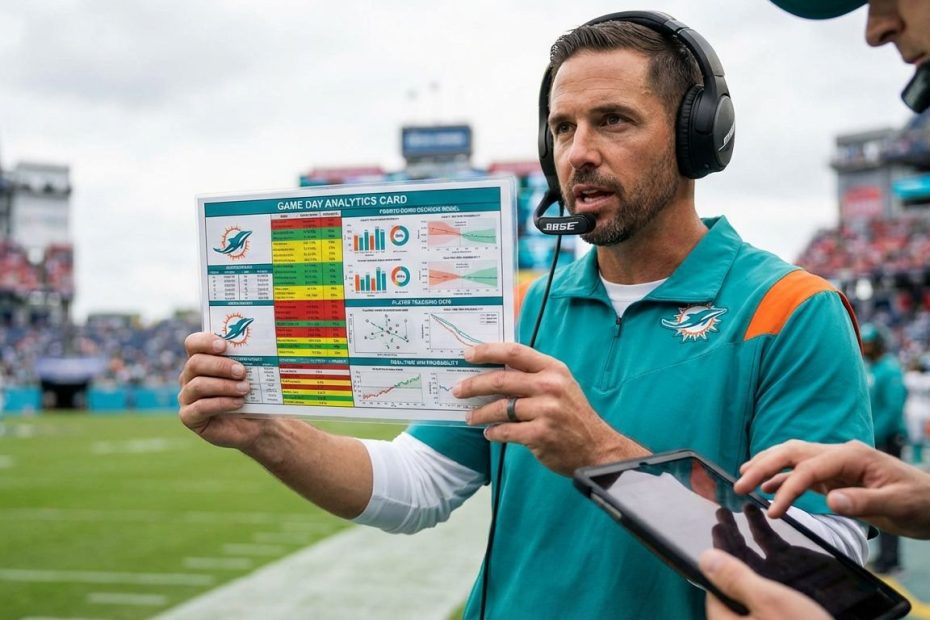
“Real-time” gets misunderstood, mostly because people picture a live dashboard driving play calls. League rules restrict technology use in the coach’s booth, which limits how analytics advisory can be delivered during games. The NFL’s own write-up on the Next Gen Stats Decision Guide notes that fourth-down advisory is limited to printable documents, often compressed to a single card. That pushes serious teams toward pre-game alignment: your thresholds and triggers need agreement before kickoff, not during a chaotic series change.
So the best use of “real-time” is usually not live play selection. It is faster validation: quicker between-series coaching points, cleaner halftime self-scout, better postgame tagging, and stronger model training for the next opponent. The point is speed of learning, not automated control of the offense.
Who Runs Analytics Inside The Dolphins Organization, And What Does That Role Do?
If you want proof that analytics is not a hobby inside the building, look at the official team staff listings. The Miami Dolphins list Ella Summer as Manager, Football Analytics on the team’s front office roster, and the club also highlights her on its “Women of the Miami Dolphins” page with the same title. When a team puts a role on the org chart, it signals process, accountability, and recurring deliverables that coaches depend on.
In day-to-day terms, that job lives at the intersection of coaching urgency and data reality. You translate tracking outputs, charting, and situational history into materials that coaches will actually use: decision cards, weekly briefs, self-scout tendency reports, and opponent scouting notes that connect directly to install periods. You also help reduce friction by standardizing how information is packaged, so position coaches are not rebuilding the same reports every week in different formats.
You also spend time managing the “last mile,” which is where most analytics programs win or lose. It is not enough to be right, you need to be usable: short, readable, and timed to the coaching calendar. If your best work arrives after install, it does not matter. If it arrives before install but can’t be rehearsed on the grass, it also does not matter.
Inside a modern NFL workflow, the analytics function becomes a performance partner to coaching, scouting, and game management. Your goal is tighter decisions, faster preparation, and fewer unforced errors under time pressure.
Do Analytics Really Change Fourth-Down, Two-Point, And Clock-Management Decisions For Miami?
Yes, analytics changes these decisions, but the biggest shift is usually upstream. You stop treating fourth down and two-point tries as spontaneous debates, and you start treating them as planned operating ranges. When the staff agrees on thresholds before game day, you remove hesitation, speed up communication, and give players clearer expectations about when aggressive calls are coming.
The NFL’s Next Gen Stats Decision Guide article explains the logic structure teams and fans now recognize: models combine win probability with conversion probability to estimate the value of options on fourth down and on two-point attempts, and the piece notes these machine-learning models run on Amazon SageMaker. The league’s point is straightforward: decision quality improves when you quantify outcomes instead of leaning only on gut feel.
The constraint is delivery. With booth technology restrictions limiting live tools, a staff can’t rely on an analyst up top running a fresh model and sending the answer down every time. You win by compressing decision guidance into something coaches can act on instantly: a one-page card, a small set of rules by field zone, plus a shared understanding of what game-state variables override the card. That is where culture and preparation matter, because a card never fits every moment unless the staff agrees how to interpret it.
Clock management follows the same logic. You gain value when you pre-plan the “two-minute operating system” for different score and timeout states, then drill it so the headset conversation stays short. Analytics doesn’t make you immune to execution failures, but it can remove avoidable confusion.
How Does Mike McDaniel’s Scheme (Motion, Speed, Spacing) Pair With Data Models?
McDaniel-style offense gives you measurable levers that translate well into tracking-based analysis. Motion can force a defense to declare man or zone, tighten or widen leverage, and trigger coverage rotations that change the math for route spacing. Speed stresses pursuit angles and spacing rules, which means separation is not only about the receiver, it’s also about how the defense fits the concept when players move fast and the ball comes out on time.
Tracking helps you validate whether those levers keep working against specific opponents. You can quantify how often a defense travels with motion, how frequently it passes off routes cleanly, and where its communication breaks when formations stack bodies. You can also check whether your own motion is achieving the intended outcome, or if defenses are starting to sit on the same indicators and keeping their structure intact.
Where this becomes real strategy is in constraint building. If opponents overplay motion tells, you need changeups that look identical pre-snap but break differently post-snap. Analytics helps you identify which constraints actually punish that overplay, and which ones only look clever on film but do not produce consistent separation or positive EPA. When the staff links those findings to install priorities, practice rep counts, and call-sheet placement, you get scheme that stays aggressive without becoming reckless.
You also protect the offense from itself. Motion-heavy systems can create operational risk: late shifts, late calls, and timing penalties. Data won’t fix that by itself, but it will show you where the cost is accumulating, which personnel groups handle complexity best, and which tempo packages reduce errors while preserving your core identity.
What Tools Stack Power NFL Tracking And Analytics (Zebra, AWS, Machine Learning), And What Can Teams Access?
The NFL’s description of Next Gen Stats makes the stack clear at a high level: tracking is developed in partnership with Zebra Technologies and Wilson, and the platform runs on AWS infrastructure. The stadium system includes ultra-wideband receivers and RFID tags across players and game equipment, which is what makes league-wide consistency possible. That consistency is the hidden advantage, because it allows cross-team comparison and stable model training.
Zebra’s public partnership announcements reinforce the maturity of the pipeline. Zebra states it renewed its partnership with the NFL as the league’s “Official Real Time Location Solutions Provider” through at least the 2025 season, continuing to fuel Next Gen Stats. That matters because you are not dealing with an experimental feed anymore, you are dealing with an established data stream that teams can build process around year after year.
Where teams separate is the “club layer.” Everyone gets the league feed, but not everyone builds the same translation machinery. The differentiator is how well you connect tracking and charting to coaching decisions: how you tag film, how you build scouting reports that match how coaches teach, how quickly you can test a hypothesis in practice, and how you preserve what works when the schedule compresses in November and December.
When a team says it has a “data revolution,” the competitive claim usually lives here: cleaner workflows, fewer handoffs, faster review cycles, and better packaging so the staff trusts the outputs. If your materials arrive late, read like a research memo, or fail to predict what coaches care about, the tech stack doesn’t matter.
What Do Dolphins Fans Get Wrong About “Analytics,” And Where Are The Real Limitations?
The most common mistake is treating analytics like a robot that replaces coaching judgment. In an NFL building, analytics is closer to quality control: it audits what you do, identifies repeatable edges, and supports game management decisions with measurable probabilities. It can push you toward smarter aggression, but it cannot block a stunt, fix a bad snap, or prevent a miscommunication in a bunch check.
Another misconception is that “real-time” equals instant, live optimization on the sideline. League rules restrict technology use in the coach’s booth, and the NFL’s Decision Guide article explains that advisory is limited to printable documents, often reduced to a single card. That makes preparation the real battlefield: you win by agreeing on decision rules early and drilling them, not by hoping a model will bail you out mid-drive.
There are also hard limits in the data itself. Tracking measures movement and location, not assignment intent, protection calls, or route adjustments that change based on coverage rules. Film and coaching knowledge remain necessary to interpret what the dots mean. When teams skip that interpretation step, analytics turns into “numbers without coaching,” and coaches stop trusting it.
The final limitation is workflow friction. If the offense struggles with tempo, communication, or late-breaking complexity, analytics can spotlight the problem but execution still decides the outcome. The best organizations use analytics to reduce the number of fragile processes that can fail on Sunday.
How Do The Dolphins Use Analytics For Game Strategy?
- Build weekly matchup plans from tracking trends
- Pre-set fourth-down and two-point decision thresholds
- Validate motion, spacing, and speed concepts with measurable results
- Package insights into coach-ready cards, cutups, and briefs
Build A Sunday-Ready Analytics Workflow
If the Dolphins’ data push teaches one lesson, it is that information only matters when it turns into a faster, cleaner decision on game day. You win when tracking data becomes coach-ready material, installed on Wednesday, rehearsed on Thursday, and trusted under pressure on Sunday. You also win when game management is treated as a planned operating system, not a debate that starts after the ball is spotted. Treat analytics as a performance tool that tightens preparation, reduces hesitation, and standardizes decision quality across the season.
References
- NFL Football Operations, “NFL Next Gen Stats” (tracking system components, partners, AWS): https://operations.nfl.com/gameday/technology/nfl-next-gen-stats/
- NFL.com, “Introducing the Next Gen Stats Decision Guide” (fourth down and two-point decision analytics, booth technology restriction, SageMaker): https://www.nfl.com/news/introducing-the-next-gen-stats-decision-guide-a-new-analytics-tool-for-fourth-do
- MiamiDolphins.com, “Front Office Roster” (Ella Summer listed as Manager, Football Analytics): https://www.miamidolphins.com/team/front-office-roster/
- MiamiDolphins.com, “Women of the Miami Dolphins” (Ella Summer): https://www.miamidolphins.com/community/women-of-miami-dolphins
- Zebra Technologies press release (Feb. 6, 2023), partnership extended through at least 2025 season: https://www.zebra.com/us/en/about-zebra/newsroom/press-releases/2023/zebra-technologies-extends-partnership-with-national-football-league.html

Barry Bekkedam is an entrepreneur and finance executive focused on investment management and advisory. A former Villanova standout and member of Canada’s men’s national basketball team, he now leads ventures in asset management and philanthropy, including the Barry Bekkedam Foundation supporting education and community development.