
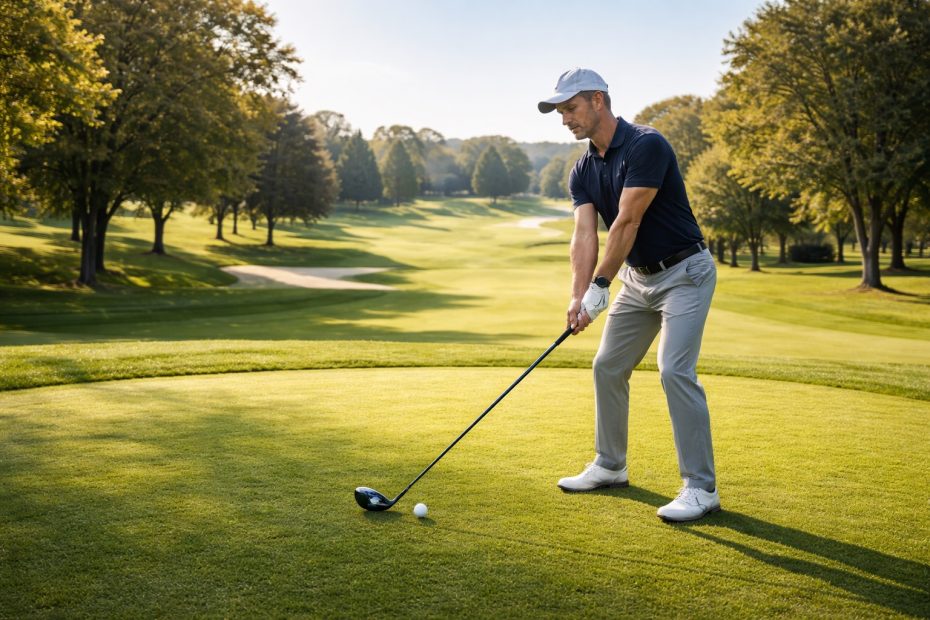
Yes, golf can help extend your competitive life as an athlete. It gives you a sport you can keep training for, measuring, and competing in long after speed, impact tolerance, and recovery start to limit what you can do in higher-contact or higher-explosive sports.
If you want to stay active, stay sharp, and stay competitive without asking your body to absorb the same punishment it did in your twenties, golf deserves serious attention. This article shows you why golf works so well across decades, what the research says about health and lifespan, and how to add it without giving up strength, mobility, or athletic identity.
Can Golf Really Help You Stay Competitive Longer?
Golf stands out because it lets you compete hard without demanding repeated collisions, sprint volume, or constant high-force landings. In many sports, your competitive window narrows when recovery slows, joint wear builds, and explosive output drops. In golf, those changes matter, but they do not end your ability to perform at a meaningful level.
You can still train, still improve, and still beat skilled opponents through precision, shot control, decision-making, tempo, and emotional discipline. Those qualities hold value deep into middle age and beyond. That is one reason golf fits so naturally into a long athletic life.
Professional golf gives you visible proof. Senior-level competition remains elite, intense, and respected, and older players continue to win. When a sport keeps producing champions well into later decades, it tells you something important about how performance ages inside that game.
The larger point is practical. Golf does not remove aging, but it lowers the physical cost of staying in competition. That matters when your goal is not just exercise, but a lasting outlet for ambition, routine, and measurable performance.
You also get continuity. Many athletes struggle when they leave the structure of organized competition. Golf fills that gap with practice plans, rankings, handicaps, tournament formats, and constant feedback. That gives you a reason to keep training with purpose instead of drifting into casual, inconsistent activity.
That competitive continuity may be the most valuable feature of all. When you can still chase progress, you are more likely to stay engaged for years. Golf keeps that engine running.
Why Do Golfers Often Compete Well At Older Ages?
Golf rewards qualities that age more gracefully than raw speed. You still need strength, mobility, balance, and coordination, but your score depends just as much on club selection, distance control, short-game touch, patience, and judgment. Those traits can sharpen with experience rather than fade from it.
In sprint-based and collision-based sports, small declines in reaction time or acceleration can change everything. In golf, a player can offset some physical decline with cleaner mechanics, smarter course management, and better emotional control. That makes the aging curve less steep than it is in many other athletic settings.
You also see this in how older golfers talk about improvement. Many lose distance, yet continue scoring well through accuracy, wedge play, and putting. That trade is far more realistic in golf than it is in sports where the contest depends on repeated maximal movement.
Another factor is the structure of the sport. Golf has competitive pathways for adults across age groups, from club events to amateur tournaments to senior professional tours. The sport does not treat aging as an exit point. It treats aging as a shift in how you compete.
That matters for motivation. If your sport gives you a runway instead of a cliff, you keep investing in practice. You maintain routine, skill, and fitness because the competition still feels real. Golf supports that better than most sports.
Experience also carries visible scoring value. Knowing when to attack, when to play safely, how to manage fatigue, and how to recover after a bad hole all matter. Older athletes often own those skills in greater depth than younger players.
Is Golf A Smart Transition Sport After High-Impact Competition?
For many athletes, yes. Golf works well as a transition sport because it preserves the parts of sport that matter most to competitive people: challenge, improvement, accountability, and pressure. At the same time, it reduces the repeated pounding that often comes with running-heavy, jumping-heavy, or contact-heavy competition.
If your knees, back, ankles, or shoulders carry years of wear, golf can keep you in motion without demanding constant high-force output. Walking the course adds steady physical activity. Swinging requires coordination, rotation, posture control, and timing. Practicing develops skill instead of just accumulating impact.
This matters even more after retirement from serious sport. Many former athletes reduce training volume sharply once their main sport ends. When that happens, weight gain, lower conditioning, stiffness, and loss of daily structure often follow. Golf can interrupt that slide by giving you a reason to keep moving every week.
It also gives you a competitive substitute that feels legitimate. That point gets overlooked. Athletes do not just miss exercise; they miss scoreboards, goals, and the satisfaction of execution under pressure. Golf delivers all of that.
You can also scale it to your body. You can play nine holes or eighteen, walk or ride, practice your short game when full swings need rest, and adjust frequency based on recovery. That flexibility helps you stay consistent instead of pushing into another cycle of pain and layoffs.
Golf does not need to replace all other training. It works best when it becomes the sport layer inside a larger performance routine. That keeps the game sustainable and keeps your body prepared for it.
What Does Research Say About Golf, Health, And Lifespan?
The research points in a favorable direction. Reviews of golf and health have linked participation with physical and mental health benefits, and one of the most discussed findings in the literature is an association between golf participation and lower mortality. The strongest wording is that golf is associated with better long-term health outcomes, not that it guarantees them.
That distinction matters if you care about accuracy. People who play golf may also differ from non-golfers in income, health habits, medical access, or social connection. Even with that caution, the signal is still meaningful. A sport that keeps people moving, outdoors, socially connected, and mentally engaged for decades has features that support healthy aging.
Golf also qualifies as moderate physical activity for many players, especially when you walk the course. A full round can produce a long duration of movement without forcing repeated maximal effort. That is a useful profile for adults who need sustainable training more than extreme training.
There is also a consistency advantage. Many exercise plans fail because they are too punishing, too isolated, or too boring to keep. Golf gives you a built-in reason to show up. Adherence matters more than intensity spikes when the goal is long-term health and performance.
Broader sports and exercise research supports this same principle. Lifelong sport participation is often linked with better cardiometabolic health, lower chronic disease burden, and stronger physical function. Golf fits that pattern well because it remains playable for a long time.
If you are evaluating golf through a performance lens, the takeaway is simple: it offers a rare mix of sustainability and competitive meaning. That combination is what makes it powerful over time.
Can Golf Help You Maintain Fitness, Mobility, And Cognitive Sharpness?
Yes, especially when you play it actively instead of passively. Walking the course raises the physical demand, increases energy expenditure, and turns a round into more than a skill session. You get sustained movement, repeated posture changes, terrain variation, and steady time on your feet.
The swing adds another layer. A sound golf swing asks for thoracic rotation, hip mobility, balance, sequencing, and force transfer. It is not a replacement for a strength program, but it does challenge movement quality in ways that support coordination and body awareness.
Golf also places useful demands on the brain. You read lies, judge wind, manage distance, regulate pace, select shots, and recover mentally after mistakes. That mix of physical and mental load helps explain why golf has drawn attention in studies looking at cognition in older adults.
There is value in the stop-start rhythm of the game as well. You do not just move; you make repeated decisions under mild pressure. That pattern trains attention and emotional regulation in a live environment. For aging athletes, that matters almost as much as the physical work.
Mobility benefits depend on how you play and prepare. If you warm up, maintain trunk and hip range, and keep your body strong enough to rotate well, golf can support functional movement over time. If you play stiff, rush to the first tee, and neglect recovery, the game can expose your weak points instead of improving them.
That is why the best golfers in later decades keep training outside the course. They preserve lower-body strength, core control, shoulder function, and balance. Golf supports those qualities, but your off-course work protects them.
What Makes Golf Different From Other Sports When You Age?
The main difference is cost. Many sports become harder to justify as you age because the physical price of training and competition rises faster than the performance reward. In golf, the price stays manageable for much longer.
You are not asked to cut, jump, sprint, collide, or decelerate at full speed over and over. You still stress the body, especially through the spine, hips, wrists, and shoulders, but the overall load is easier to distribute across a week and across a season. That changes what longevity looks like.
Golf also allows more compensation through intelligence and repetition. A basketball player cannot think his way around a lost vertical jump on every possession. A golfer can shape a game around precision, misses, and course management. That makes the sport more forgiving of normal age-related decline.
The social structure helps too. Golf is built for mixed ages and mixed ability levels. You can compete with peers, play with stronger or weaker partners, and still get a legitimate test. That keeps you connected to the game instead of pushing you out when you are no longer at a physical peak.
There is also less pressure to retire from identity. In some sports, you stop playing and become a spectator. In golf, you can stay a player. That difference matters if competition has been part of how you define yourself for years.
Older athletes often perform better when they can preserve that identity in a realistic setting. Golf gives you one of the clearest ways to do it.
What Can You Learn From Older Elite Golfers?
Older elite golfers show that skill can stay sharp when training stays smart. They do not succeed because aging stops affecting them. They succeed because they manage their bodies, their schedules, and their games with discipline.
At advanced competitive ages, elite golfers still build around preparation. They protect mobility, monitor workload, preserve technical efficiency, and sharpen scoring clubs. They do not chase the same physical profile they had decades earlier. They refine the qualities that still move scores.
You can apply the same model without being a professional. Build your practice around what matters most: contact quality, short game, putting, wedge distance, and strategy. If your speed dips a little, tighter execution can protect scoring more than another hour spent swinging as hard as possible.
There is also a lesson in patience. Older successful golfers tend to make fewer emotional mistakes. They understand where bogey is acceptable, where the smart miss lives, and when discipline beats ambition. That kind of control gets stronger with age if you train it intentionally.
Another lesson is body management. The players who last tend to respect recovery. They warm up, maintain range of motion, and avoid practicing in ways that create useless fatigue. Longevity is built on repeatable preparation.
If you want your own competitive life to stretch, copy the process instead of admiring the result. The process is what travels across age.
What Do Everyday Golfers Say About Playing Later In Life?
Everyday golfers tend to describe the same pattern: less power, better judgment, and more appreciation for consistency. That aligns with what experienced coaches and long-term players see all the time. The game changes, but it does not disappear.
Many older players report that they score better when they stop fighting for distance on every swing. They become more efficient, manage the course better, and rely on cleaner contact and short-game control. That shift often makes the game more satisfying, not less.
There is also a strong durability theme. Golfers who move into the game after years in other sports often talk about relief. Their bodies still need maintenance, yet the activity feels sustainable in a way their earlier sport no longer did.
Another common point is community. A sport you can play with people of different ages and still enjoy has staying power. Golf creates regular social contact without removing the competitive element, and that mix helps people stick with it.
You should not dismiss those lived patterns just because they are not laboratory findings. Real participation depends on what people will keep doing. Golf keeps people engaged because it remains challenging and rewarding across a wide age range.
That long-term adherence may be one of its strongest advantages. A useful training method is only useful if you keep showing up for it. Golf makes that easier.
How Should You Add Golf Without Losing Strength Or Athletic Edge?
Treat golf as an addition to performance training, not a replacement for it. If you want to stay capable, keep strength work in your week. Your body still needs force production, tissue capacity, and joint support, especially if you want to swing well for years.
A simple structure works. Keep two to three strength sessions built around lower-body training, pulling strength, trunk stability, and rotational control. Add mobility work for hips, thoracic spine, shoulders, and ankles. Then use golf for skill, moderate conditioning, and competition.
Walking whenever practical improves the physical value of the game. It adds steady aerobic work and time on your feet. Riding can still be useful on busy weeks or for recovery, but if longevity is your goal, walking gives you more return.
You also need to respect volume. Too many players jump into full swings without gradually building tolerance in the back, elbows, wrists, and lead hip. Build range time slowly, keep technique clean, and stop treating fatigue as productive.
Short-game practice is another smart lever. It sharpens scoring without pounding your body. If your schedule is full, a focused short-game session plus strength work may do more for your long-term performance than another bucket of full-speed drivers.
Recovery habits matter too. Warm up before every round, cool down when needed, hydrate, and maintain sleep quality. Competitive longevity is not built from one perfect workout. It is built from repeatable habits that keep you available.
Can Golf Replace Your Main Sport, Or Should It Support It?
For most athletes, golf should support your bigger training plan rather than replace it outright. Golf delivers competitive value and moderate physical activity, but it does not cover every physical quality you need for durable performance.
You still need resistance training for muscle and tendon health. You still need mobility work to maintain clean movement. You still need some conditioning outside the course if your general fitness has slipped. Golf fits best when it sits inside that larger plan.
That said, golf can become your main sport if your previous one no longer makes sense for your body. Many athletes reach that stage. The smart move is not to force a return to the old demands. The smart move is to shift into a sport you can sustain and still care about.
If golf becomes your primary outlet, keep the athletic standard high. Train for swing speed safely, improve rotational strength, monitor movement quality, and set performance goals. The game rewards disciplined preparation.
What you do not want is the false choice between being athletic and being a golfer. That is the wrong model. Golf can be the sport that preserves your athletic habits when other sports stop being practical.
Viewed that way, golf is not a fallback. It is a long-term competitive platform.
What Is The Real Reason Golf Extends Athletic Longevity?
The real reason is not just lower impact. It is the blend of sustainable physical demand, measurable competition, social connection, and skill depth. Few sports give you all four for this long.
You stay engaged because the game keeps asking for something from you. It asks for discipline, patience, movement quality, problem-solving, and emotional control. Those demands keep you invested long after casual exercise would lose your attention.
You also keep getting feedback. Scores, handicaps, greens in regulation, fairways hit, scrambling, putting statistics, and tournament results all show you where you stand. Athletes thrive on that kind of signal. It turns activity into a mission.
The body can handle that mission for longer because the stress is more manageable than it is in many traditional competitive sports. That is the formula. Lower physical cost, long skill runway, strong adherence, and continued access to competition.
If your goal is to preserve a competitive life instead of just stay busy, golf has unusual value. It gives you a serious pursuit that can stay with you for decades.
That is why golf deserves a place in any honest conversation about sports longevity. It does not stop the clock, but it gives you a much better way to keep playing while the clock keeps moving.
Can Golf Extend An Athlete’s Competitive Life?
Yes, golf can extend your competitive life by reducing impact, rewarding skill and strategy, supporting long-term fitness, and giving you a sport you can keep playing and improving at for decades.
Keep Competing Longer With A Smarter Game
If you want a sport that lets you stay active, stay sharp, and stay competitive well beyond the years when explosive sports start taking more than they give back, golf is one of the strongest options available. It rewards skill, discipline, and experience in a way few sports can match across a long athletic life. It also supports steady movement, social connection, and real performance goals, which makes it easier to keep showing up year after year. Add it to a sound strength and mobility routine, and you give yourself more than a pastime; you give yourself a sustainable competitive path. That is the real value of golf for aging athletes: not escape from effort, but a better way to keep earning meaningful results.
References
- The Relationships Between Golf And Health: A Scoping Review – PubMed
- Golf And Physical Health: A Systematic Review – PubMed
- Golf: A Game Of Life And Death—Reduced Mortality In Swedish Golf Players – PubMed
- Health Benefits Of Different Sports: A Systematic Review And Meta-Analysis Of Longitudinal And Intervention Studies Including 2.6 Million Adult Participants – PubMed
- Cognitive And Biomarker Responses In Healthy Older Adults To A 18-Hole Golf Round And Different Walking Types: A Randomised Cross-Over Study – PubMed Central
- Prevalence Of Chronic Conditions In Masters Games Athletes: Predictors And Comparison To The General Population – PubMed Central
- Champ4life Study Protocol: A One-Year Randomized Controlled Trial Of A Lifestyle Intervention For Inactive Former Elite Athletes With Overweight Or Obesity – PubMed Central
- Slow-Ripening Success – PGA TOUR
- Bernhard Langer Leads Notable Numbers From 2023 PGA TOUR Champions Season – PGA TOUR
- Bernhard Langer Wins U.S. Senior Open For Record 46th PGA TOUR Champions Title – PGA TOUR
- Are You An Average Golfer? – United States Golf Association
- Seeking Advice On How To Keep Our Bodies In Shape To Play Into Our Later Years – Reddit
- Playing With Old, Good Golfers Changed My Game – Reddit

Barry Bekkedam is an entrepreneur and finance executive focused on investment management and advisory. A former Villanova standout and member of Canada’s men’s national basketball team, he now leads ventures in asset management and philanthropy, including the Barry Bekkedam Foundation supporting education and community development.