
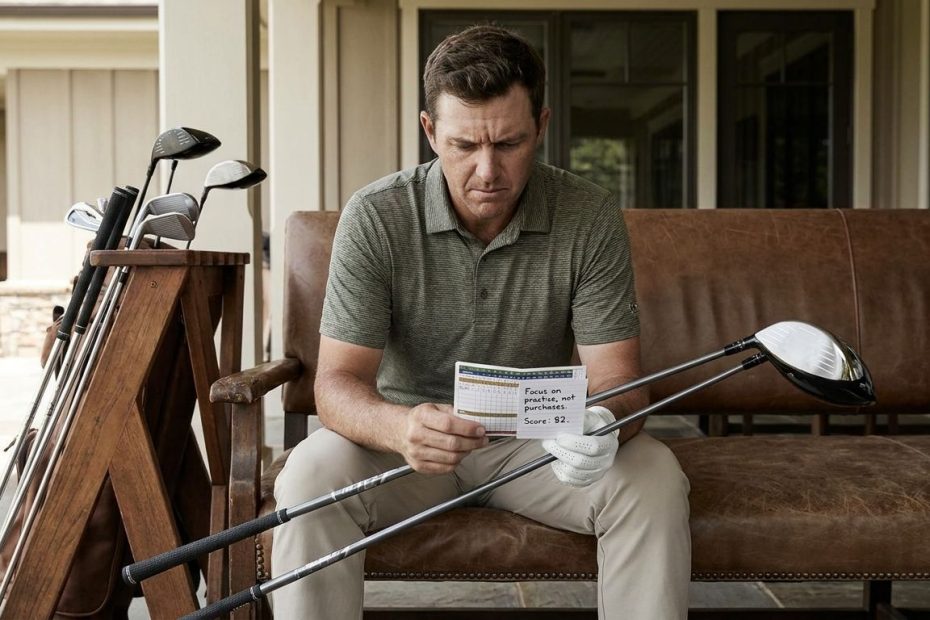
The club upgrade trap happens when you buy new golf clubs before you know which shots are actually costing you strokes. New equipment can help, but it won’t lower your score if your biggest losses come from penalties, poor yardage control, three-putts, bad targets, or recovery shots.
If you’re stuck shooting the same numbers, you need a buying plan based on evidence, not launch-day excitement. You’ll see when new clubs make sense, when lessons come first, what to track before spending money, and how to upgrade your golf bag without turning your credit card into a swing coach.
Do New Golf Clubs Actually Lower Your Score?
New golf clubs can lower your score when they solve a real performance problem. That problem might be poor club fit, worn wedge grooves, gaps between distances, a driver that launches too low, or irons that punish every off-center strike. The mistake is expecting a new model to erase the same swing pattern, target habit, or short-game weakness that shows up every round.
Shot-tracking data makes the trap easy to spot. Amateur scoring is shaped by repeatable patterns: tee shots in trouble, approach misses, short-game waste, and putting mistakes. A new driver that adds ten yards does not help much if those ten yards send your miss deeper into trees, bunkers, or penalty areas.
Your scorecard does not care that one ball carried farther in a simulator. It cares how many shots you waste from the tee, how often you miss greens in playable places, and whether your first putt leaves you a simple second putt. If the club does not reduce a repeated mistake, it may improve your bag without improving your score.
That does not mean equipment is useless. Better forgiveness, correct shaft weight, proper lie angle, fresh grips, and cleaner wedge spin can all make the game easier. The point is simple: the club that lowers your score is the one that removes a pattern, not the one with the newest badge.
Should You Buy New Clubs Or Get Lessons First?
If your score has not moved for months, lessons usually come before a major club purchase. A qualified golf instructor can identify whether your issue is contact, face angle, swing path, setup, tempo, club delivery, or decision-making. Buying clubs before that diagnosis often locks you into equipment that fits a problem you’re about to change.
There are exceptions. If your clubs are the wrong length, the grips are slick, the shafts are far too stiff, the irons are old blades you can’t launch, or the wedges have little bite left, equipment is part of the problem. In that case, a lesson paired with a basic equipment check gives you a cleaner path than guessing from a hitting bay.
A good lesson does more than fix a move. It tells you what your golf swing is asking the club to do. If you’re steep with long irons, a hybrid may help; if your driver launches low with too much curve, loft and shaft profile matter; if your wedges run out on every partial shot, fresh grooves or better bounce may be needed.
The order matters because your swing and equipment influence each other. If you spend a large sum on clubs, then change your motion two weeks later, you may have purchased the wrong specs. Get your motion stable enough to measure, then fit the tools around the swing you plan to keep.
Is Club Fitting Worth It For High Handicappers?
Club fitting can be worth it for high handicappers, but the goal must be practical. You’re not paying for a magic wand; you’re checking whether the clubs make reasonable contact, launch, distance control, and direction easier. A fitting is valuable when it removes a mismatch, not when it becomes a shortcut around practice.
High-handicap golfers can benefit from the basics: correct length, lie angle, grip size, loft, shaft weight, shaft flex, and head design. These details matter because poor fit makes an already difficult game harder. Clubs that are too long, too flat, too upright, or too demanding can turn decent swings into predictable misses.
The limit is contact quality. If your strike location moves across the face with no pattern, a premium fitting session can produce noisy numbers. You may still learn useful things, but it makes sense to start with a simpler fit check before building an expensive full bag.
Think of fitting in levels. A basic fit tells you whether your clubs are wildly wrong. A gapping session tells you whether your distances make sense. A full custom build makes sense when your strike pattern is steady enough to compare dispersion, launch, spin, and carry distance with confidence.
When Do New Clubs Actually Help You Score Better?
New clubs help when they remove a measurable disadvantage. If your 4-iron never gets airborne, replacing it with a hybrid can save shots. If your wedges are worn and you can’t control release on short shots, new wedges can improve stopping power and distance control.
Game-improvement irons can help if your misses lose too much ball speed or curve too far offline. Modern iron heads often place more weight around the perimeter, which can reduce the penalty on off-center contact. You still need to strike the ball, but the club can make your normal miss less expensive.
A driver upgrade makes sense when launch, spin, face strike, and dispersion improve across several swings, not one perfect swing. If you hit ten balls with the old driver and ten with the new one, the useful question is not which single shot went farthest. You need to know which club keeps more balls playable and gives you better average distance.
Wedges deserve special attention because they wear faster than most clubs. The grooves interact with the ball and turf on shots where spin and control matter. If you play regularly, especially on sandy ranges or firm turf, wedge performance can fade before the rest of your set feels old.
Putters are different. A putter can last for years if the weight, length, aim, face feel, and confidence match your stroke. Replace it only when you can prove the new one starts the ball on line better, controls pace better, or makes your setup more repeatable.
Why Do You Hit New Clubs Farther In A Simulator But Shoot The Same Score?
Simulator distance can be useful, but it can also fool you. Indoor swings happen on flat lies, with no wind, no rough, no pressure, and no penalty area waiting on one side. The longest shot in a session can make a club feel like a breakthrough, but golf rewards the average, not the highlight.
Distance matters in golf. Better players tend to hit it farther, and data shows a clear gap in driving distance between scratch golfers and mid- or high-handicap golfers. The missing detail is that distance only helps when it stays useful, playable, and predictable.
If your new driver adds twelve yards but widens your left miss, your score may stay the same or get worse. If your new irons fly farther because the lofts are stronger, you may own a longer 7-iron without gaining better approach play. Yardage without stopping power, height, or control can create a new problem under a nicer headcover.
The same trap shows up with fairway woods and hybrids. A club that flies far from a perfect lie may fail from the rough, a downslope, or a tight fairway. You need the club that performs under the shots you actually face, not the club that wins one launch-monitor contest.
Your score changes when distance reduces stress. That means shorter approaches from playable spots, fewer forced recovery shots, fewer lost balls, and more routine pars or bogeys. Longer is good when it keeps you in the hole; longer into trouble is just an expensive detour.
What Should You Track Before Upgrading Clubs?
Track five rounds before you buy anything expensive. You don’t need a tour-level data team; you need honest numbers from your own golf. Record penalty shots, tee shots in serious trouble, three-putts, greens missed short, approach direction, wedge misses, and any club that produces duplicate yardages.
Your carry distances matter more than your best total distances. A lot of golfers choose clubs based on the shot they remember, not the shot they hit most often. If your 7-iron once flew 165 yards but usually carries 150, choosing it from 165 creates short misses all day.
Build a simple yardage chart with real carry numbers. Use a launch monitor, range balls adjusted with caution, on-course shot tracking, or a gapping session with a professional. The goal is to know your normal distance, your strong strike, and your miss distance for each club.
Track where your approach shots finish. If you’re short most of the time, new irons may not be the answer; you may need better club selection. If your misses are mostly right, a lie angle check, grip change, lesson, or setup fix may beat a full iron replacement.
Track your driver in two categories: playable and costly. A ball in the rough with an angle to the green is not the same as a ball in trees, water, out-of-bounds, or behind a trunk. Your upgrade decision should focus on reducing costly tee shots, not just raising ball speed.
Track putting with pace in mind. If you three-putt often from long range, a new putter face may not solve the issue. You may need distance-control practice, better green reading, or a putter fitting that improves length, loft, lie, and alignment.
How Often Should You Upgrade Golf Clubs Without Falling Into The Trap?
Upgrade when the club no longer fits your swing, your yardages, your confidence, or the job you need it to perform. Don’t upgrade because a new model launched. Golf equipment companies release fresh gear often, but your scorecard does not reset with the product cycle.
A practical upgrade rhythm looks like this: drivers and fairway woods every few years if performance data supports it, irons far less often, wedges more frequently, and putters only when the fit or performance demands a change. Your play volume matters too. A golfer playing twice a month wears equipment at a different rate than someone playing and practicing several days a week.
Grips deserve a lower-cost check before you blame the heads or shafts. Worn grips make you squeeze harder, lose face control, and feel less secure through impact. Regripping can make old clubs feel sharper without replacing the whole set.
Loft and lie checks are also worth doing. Irons and wedges can shift from repeated turf impact, travel, and long-term use. If your distance gaps suddenly look odd, the answer may be a bending machine, not a new box of irons.
Follow one rule: replace the club that costs you the most strokes first. If your wedges are costing you control around the green, don’t buy a driver because it looks good on the shelf. If your driver creates four recovery shots per round, don’t spend the budget on a new putter because it feels fresh indoors.
What Is The Real Cost Of Chasing Equipment Instead Of Scoring?
The real cost is not just money. It’s time, attention, and the habit of blaming tools before measuring performance. A premium driver can cost hundreds of dollars, but the bigger loss comes when you spend a season chasing ball speed and never fix the shot that creates doubles.
Golfers are surrounded by upgrade messaging because the equipment market is active. Drivers, fairway woods, irons, wedges, putters, shafts, grips, and launch monitors all compete for your attention. Some of those products can help, but they help most when you match them to a known need.
The trap becomes expensive when every bad round creates a shopping list. You miss a few putts, so you browse putters. You block two drives, so you test new shafts. You leave three approach shots short, so you start comparing irons before checking your actual carry numbers.
That cycle keeps your score in place because it changes the purchase, not the pattern. You need a record of what happened on the course. Once you know the pattern, spending becomes targeted, and targeted spending is where equipment starts to pay you back.
How Do You Decide If A Club Upgrade Is Worth The Money?
Use a simple test: the new club must beat your current club in the metric that affects your score. If you’re testing a driver, measure playable distance, dispersion, launch, spin, and serious misses. If you’re testing irons, measure carry gaps, height, stopping power, directional pattern, and off-center performance.
Do not judge a club by the best ball. Judge it by the cluster. A new club that produces one monster shot and nine loose ones is not a scoring upgrade; it’s a story you’ll tell after the round.
Bring your current club to every test. Hitting a new driver without comparing it to your gamer gives you no baseline. A proper test needs the same ball type, similar warm-up, enough swings, and numbers that show averages, not just peak output.
Ask three questions before buying. Does this club reduce a miss that costs strokes? Does it create a better yardage gap? Does it make the game easier under real course conditions? If the answer is no, wait.
You should also compare the club purchase to lessons, fitting, practice tools, and playing time. A few lessons plus regripped clubs may beat a full iron purchase. A wedge fitting and a distance-control plan may save more shots than a new fairway wood you hit twice per round.
Are New Golf Clubs Worth It?
- New clubs are worth it when they fix fit, wear, launch, gapping, or forgiveness.
- They are not worth it when penalties, three-putts, poor targets, or bad yardages cause your score.
- Track five rounds before buying.
Buy The Club That Removes A Mistake
New golf clubs are not the enemy; blind upgrades are. If you want lower scores, start by proving where your strokes disappear, then buy only the equipment that fixes a real problem. Lessons, fitting, gapping, regripping, wedge replacement, and smarter targets can all beat a flashy purchase when they address the right leak. Your best upgrade may be one club, one spec change, one lesson plan, or one honest yardage chart. The smartest golfers do not stop buying equipment; they stop buying guesses.
References
- Shot Scope Releases Annual Golf Report
- USGA: Golf Boomed in 2025
- How Far Does The Average Amateur Golfer Drive?
- 6 Things All Scratch Golfers Do That You Don’t
- How Often Should You Upgrade Your Golf Clubs?
- What Happens During the Collision Between Club and Ball?
- Digging Into Your Numbers: Strokes Gained Insights
- Adult Golf 3-Pack Lessons
- Golf Datatech: Equipment Sales Show Strength

Barry Bekkedam is an entrepreneur and finance executive focused on investment management and advisory. A former Villanova standout and member of Canada’s men’s national basketball team, he now leads ventures in asset management and philanthropy, including the Barry Bekkedam Foundation supporting education and community development.