
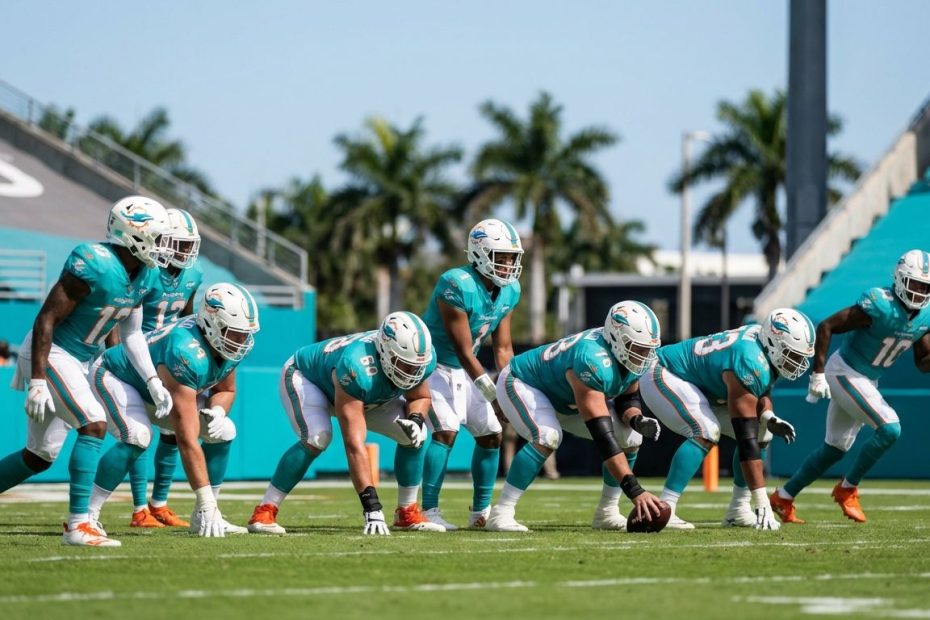
The Dolphins’ offense earns the “innovative” label because it does more than chase speed. You can watch Miami stress defenders before the snap, during the snap, and after the snap with motion, condensed alignments, timing manipulation, and spacing that forces mistakes.
If you want to understand why this offense still matters, you need to look past raw point totals and study how it changes defensive rules. What follows breaks down the exact ideas that make Miami different, why the system looked less dominant at times, and why the rest of the National Football League still reflects many of the concepts this offense pushed into the mainstream.
Why Is The Dolphins’ Offense Considered Innovative?
If you study offense for long enough, you stop judging innovation by play-call volume and start judging it by stress creation. That is where Miami separates itself. The Dolphins do not rely on random gadget football. They build plays that force defenders to declare coverage, widen their leverage, communicate under pressure, and react to speed that is already in motion before the ball is snapped.
You can see that innovation in how the offense layers problems. A receiver motions across the formation, a defender bumps over, the safety rotates, the box count shifts, and the quarterback gets a cleaner picture before the snap. That is not decoration. That is information theft. Miami turns movement into a tool for diagnosis, then turns that diagnosis into leverage on the play itself.
The offense also uses condensed formations in a sharp way. When receivers align tighter to the formation, defenders lose comfortable spacing on the perimeter. Corners have less room to press, safeties get pulled into tougher support angles, and outside grass opens up for speed players who only need a small crease to create an explosive gain.
This is why Miami can look simple on the broadcast copy and still be advanced on the coaching tape. A slant, over route, screen, toss, or outside run may look familiar. What changes is how the offense gets into it, what leverage it steals before the snap, and how many wrong answers it creates for the defense once the play starts.
That is also why the offense has influence beyond its own weekly stat line. Teams across the league use motion. Many offenses use bunches and stacks. More coordinators now care about forcing defenders to adjust late. Miami helped turn those ideas into weekly operating principles rather than occasional changeups.
When people reduce the Dolphins to “they are just fast,” they miss the design element that makes speed matter. Plenty of teams want speed. Few build an entire structure that lets speed arrive on time, in space, with favorable leverage, and with the defense already off balance. That is innovation in football terms. It is not style. It is engineering.
What Exactly Is “Cheat Motion,” And Why Did The Dolphins Make It Famous?
“Cheat motion” became the phrase many fans attached to Miami’s fastest pre-snap movement. The idea is straightforward. A receiver starts in short motion and hits the snap already building speed, which reduces the cornerback’s ability to disrupt the release and gives the route a built-in acceleration advantage.
You do not need a clinic tape to understand why that matters. Defensive backs want early contact, stable leverage, and clean visual keys. Cheat motion attacks all three. The receiver is no longer static, the release point shifts, and the snap arrives at a moment that forces defenders to process movement and route threat at the same time.
For Tyreek Hill and Jaylen Waddle, that timing change turns dangerous speed into near-immediate stress. A corner cannot sit comfortably at the line and land two hands on the release when the receiver is already moving. A nickel defender cannot casually pass off motion when the ball may snap at the exact moment that motion changes the route angle. Safeties also get dragged into faster decisions, which opens windows elsewhere.
The useful way to think about cheat motion is not as a trick but as a delivery system. Miami is delivering elite speed into the play with better launch conditions. That changes route timing, pursuit angles, tackling leverage, and even how linebackers fit the run when they are worried about sweep action, glance routes, or quick perimeter throws.
This part often gets lost in fan discussion: cheat motion is only one branch of a larger offensive tree. The Dolphins did not build a respected offense on one gimmick. They built it on movement married to spacing, route timing, run action, and quarterback-friendly pictures. Cheat motion simply became the symbol people recognized fastest because it looked different and produced visible strain on defenses.
You can also measure its impact by imitation. Concepts do not spread across the league unless coaches believe they solve real problems. Miami gave offenses a cleaner method to protect speed releases, sharpen timing, and create stress before the snap. Once that idea enters league circulation, the origin point matters. The Dolphins helped push it into common use.
Are The Dolphins Still One Of The National Football League’s Leaders In Motion And Pre-Snap Disguise?
Yes, and that matters more than many people realize. Once the rest of the league started using more motion, some of Miami’s edge became less visible to casual viewers. Motion became normal television football. That visual familiarity made the Dolphins seem less original, even though their volume and intent still sat near the front of the sport.
League-wide motion use has climbed over time, yet Miami stayed above the average operating level under Mike McDaniel. That is a crucial distinction. Many teams adopted motion as a feature. Miami built it into the identity of the offense. The Dolphins do not just motion to motion. They use movement to create clearer reads, sharper angles, and manufactured mismatches that show up in the structure of the play call.
Pre-snap disguise also works hand in hand with quarterback efficiency. When defenders travel with motion, the quarterback gets clues about man coverage. When the secondary bumps and rotates, the offense gathers spacing information. When a linebacker widens with jet action, the run fit changes. These shifts may look small on television, yet they shape where the ball goes and why the play has a chance before the snap even happens.
This is where coaching value shows up. A coordinator can call a route concept from the same family all game long, but the pre-snap picture alters how the defense handles it. Miami has been especially good at using similar movement patterns to package multiple threats. A defense sees one motion and has to prepare for several outcomes: inside zone, perimeter run, play-action shot, fast screen, over route, crosser, flat control, or a quick hitter breaking behind overreaction.
That sustained commitment is why Miami still deserves credit as a movement offense with real identity. The league borrowed pieces of the formula, yet the Dolphins continued living in that world at a higher rate than most teams. When a trend becomes standard, the team that helped make it standard often gets underrated. That is exactly what happened here.
You can put it another way. When everyone starts speaking a language that one team helped popularize, the original voice can seem less distinctive. On tape, though, Miami still speaks it more fluently than most. The motion is not random noise. It is the grammar of the offense.
If The Scheme Is So Smart, Why Did The Dolphins’ Offense Drop Off?
This is the question that separates surface analysis from serious football analysis. A smart scheme does not guarantee elite output every week. Design creates answers, but execution still decides whether those answers produce points. Miami’s offense can remain inventive and still produce frustrating stretches when protection, timing, quarterback play, short-yardage execution, or drive sustainability slip.
Raw production painted a mixed picture. The Dolphins were not functioning like the most explosive version of themselves when the offense first captured national attention. Points per game, total yardage, and third-down conversion performance all suggested an attack that could still move the ball in patches but struggled to finish drives and avoid stalled possessions.
Advanced team numbers tell the same story with more detail. Miami still generated respectable efficiency in parts of the run game and maintained useful yards-per-play figures relative to struggling offenses, yet sacks allowed, interceptions, and negative-play pressure undercut the design. That profile usually points to a scheme that still creates opportunities but no longer covers every flaw around it.
Protection matters here more than many fans want to admit. Motion and spacing can distort a defense, but they do not erase instant pressure. If the quarterback cannot hitch, reset, or trust the pocket, route timing becomes less stable. If quick-game answers are anticipated, the offense starts living on smaller margins. That is when precision-based attacks feel less invincible.
You also saw the effect of defensive patience. Early versions of the Dolphins could blow games open with explosive gains that tilted everything. Once opponents got better at staying on top of vertical speed and forcing underneath completions, Miami had to sustain longer drives. That demands clean execution snap after snap. Any slippage in blocking, accuracy, timing, or penalties becomes more expensive.
So the offense did not stop being clever. It became more dependent on perfect operation than the highlight reels suggested. That distinction matters. Some systems survive disorder better than others. Miami’s system is built to punish hesitation and leverage mistakes, but it also asks for precision. When the details drift, the offense can look ordinary faster than its design quality would suggest.
Did Defenses Figure Out Mike McDaniel’s Offense?
Defenses did not “solve” it in the simple way that talk shows like to imply. What happened is more technical and more believable. Opponents learned where the pressure points were, trained for the motion rules, tightened communication, and played with more discipline against the eye candy that once forced panic.
Early on, Miami’s speed and motion package produced hesitation. Defenders widened too fast, safeties overcommitted, linebackers stepped toward motion, and corners lost control of leverage. Once teams gathered more tape and built clearer answers, the panic reduced. That does not mean the offense became easy to stop. It means the free mistakes were harder to generate.
You can see the adjustment pattern in how defenses handled explosive threats. More secondaries worked to stay over the top and squeeze vertical space. More corners challenged routes with smarter positioning rather than reckless lunges. More defenses accepted smaller underneath gains to prevent game-breaking explosives. That shifts the burden back onto Miami to string together long drives instead of living off chunk plays.
Physical disruption at the line also mattered. Motion helps reduce clean jams, yet disciplined defenses can still muddy timing with reroutes, leverage collisions, and layered zone spacing. Once the offense loses a fraction of a second, windows shrink. Timing attacks often survive on small margins, and small margins disappear quickly when defenders stop chasing every false key.
The most important point is this: defensive adaptation is evidence of influence. Teams change rules for offenses that matter. Coaches spend offseason time on alignment checks, motion communication, safety fits, and release disruption when they believe the offense on the other side has changed the stress map of the sport. Miami forced those conversations around the league.
So if someone says defenses figured Miami out, the sharper response is that defenses invested major resources in catching up. That is not a dismissal of innovation. It is proof that the innovation worked well enough to demand a league-wide reply.
How Much Of Miami’s Offense Is Scheme, And How Much Is Just Speed Talent?
The honest answer is that the Dolphins are powerful because the talent and the design are fused. You cannot separate them cleanly. Tyreek Hill, Jaylen Waddle, and De’Von Achane give the offense rare acceleration. The scheme then turns that acceleration into leverage stress that defenders feel on every level of the field.
Pure speed alone does not create a great offense. Plenty of fast teams never reach this level of structural pressure. Miami pairs speed with stacked releases, reduced splits, motion timing, angle creation, run-action conflict, and route combinations that punish overreaction. That is why the offense can produce stress on a simple crosser, quick toss, glance route, or screen. The athletes matter, but the design determines how often those athletes touch the ball in favorable conditions.
The run game is a strong example. Miami’s rushing attack has been more than handoffs to quick backs. It uses formation spacing, motion influence, and horizontal stretch to widen support defenders and create cleaner lanes. When a defense has to honor perimeter motion and route speed, interior run fits can soften by just enough to produce efficient gains. In football, “just enough” is often the difference between a two-yard run and a twelve-yard run.
Quarterback dependency also proves the point. This offense asks for timing, anticipation, fast processing, and trust in landmarks. If it were only about raw speed, quarterback variation would matter less. Yet timing-based structure means the passer has to deliver on schedule and understand where motion has shifted leverage. That dependence on sequencing shows how designed the system really is.
It is also why the offense can feel less forgiving than people expect. Highly tuned systems generate big rewards when the parts sync up. They also expose breakdowns quickly. A late read, poor protection call, mistimed motion, or disrupted route can throw off an entire play. That does not weaken the argument for innovation. It strengthens it. Precision systems generate rewards through precision itself.
If you want the cleanest way to say it, Miami is not just fast. Miami is organized speed. That is a different category, and it is the one that creates lasting influence across the league.
What Is The Best Evidence That Miami Changed How National Football League Offenses Operate?
The strongest evidence is not a single highlight or one dominant month. It is the spread of the ideas. Motion usage across the league kept rising, condensed formations gained wider use, and offenses put more attention on how to create easier leverage before the snap instead of asking every play to win only after the snap.
Miami helped accelerate that shift by showing how movement could become a central operating system rather than a changeup. The offense made pre-snap motion feel less like decoration and more like a tool for identification, manipulation, and launch timing. Once that lesson became visible, other coaches borrowed from it. That is how tactical influence works in professional football. One team stretches the edge, then others adapt the principle to their own rosters.
You can also look at how discussions around offense changed. More analysts and coaches now talk openly about spacing, leverage, conflict defenders, condensed splits, motion rate, and stress creation. Those ideas existed long before Miami, yet the Dolphins helped push them into mainstream football language. When a team changes what people notice, that team has moved the sport.
The copycat effect matters here. The National Football League is ruthless about stealing useful ideas. Nobody protects originality for its own sake. If a concept creates even a small weekly advantage, other staffs study it, trim it, rename it, and install their own version. Miami’s fingerprints showing up in wider league behavior is one of the strongest signs that the offense mattered beyond its own box scores.
This is why “underrated” fits the title. Once your ideas spread, your originality becomes harder to spot. Fans start seeing motion everywhere and assume everybody arrived there equally. That is rarely how football innovation works. A few teams push hard enough to reset the standard. Miami was one of those teams.
So when you evaluate whether the Dolphins were innovative, do not stop at whether they finished as the top offense at one moment. Ask whether their ideas changed coaching behavior, defensive rules, and offensive design language across the sport. On that test, Miami’s case is strong.
What Should You Watch To Understand The Dolphins’ Offense Like A Veteran Evaluator?
If you want to study Miami with sharper eyes, stop following the ball first. Watch the defense before the snap. Notice whether a corner travels with motion, whether the nickel bumps inward, whether the safety rotates down, and whether linebackers widen with jet action. Those reactions tell you what the offense is trying to reveal and distort.
Then watch receiver alignment. Condensed splits matter. Stack looks matter. Tight formations matter. They change access routes, pursuit angles, and how defenders can use the sideline as help. When a fast receiver starts from a reduced split with motion attached, the defense is often playing with less clean leverage than it appears.
Watch the launch point of the play. Is the quarterback getting a quick answer off motion? Is the run game using horizontal influence to widen the box? Is the route concept hitting behind defenders whose eyes were dragged by movement? Once you start tracking those details, the offense stops looking like random speed and starts looking like controlled pressure applied to exact spots on the defense.
Pay attention to what happens when Miami is forced off schedule. Third-and-long, quick interior pressure, penalties, and short-yardage failures reveal the stress points of the system. Great analysis is not only about what works at its best. It is about understanding the conditions the offense needs in order to function at full value.
You should also watch how opponents defend the same motion over time. Are they chasing it? Are they bumping calmly? Are they staying deep and forcing checkdowns? That tells you where the league has adjusted and where Miami still holds an edge. Football study becomes much clearer once you see every snap as a leverage problem rather than a collection of isolated plays.
When you view the Dolphins through that lens, the offense becomes easier to appreciate. You are not just watching who got open. You are watching how Miami created the space, stole the information, and forced the coverage to bend before the play had a chance to settle.
Why Is The Dolphins’ Offense Innovative?
- Uses pre-snap motion to expose coverages and shift leverage
- Builds speed into the snap with cheat motion and timing control
- Uses condensed formations to open outside space
- Forces defenders to handle run and pass stress at once
- Influenced league-wide offensive design beyond Miami’s own results
See The Design, Not Just The Highlights
If you judge the Dolphins only by whether every drive ends in fireworks, you miss what makes the offense worth studying. Miami earned respect by turning motion, alignment, timing, and spacing into a repeatable pressure system that forces defenses to solve hard problems before the snap and after it. Production can rise and fall, and defenses can sharpen their counters, yet the architecture still matters because it changed how offenses think about creating space and speed. That is why the unit remains underrated: many of its best ideas now look familiar only because the rest of the league borrowed them. If you keep watching the leverage, the geometry, and the pre-snap manipulation, you will see an offense that still says more about the future of football than many people admit.
References
- https://www.pff.com/news/nfl-pre-snap-motion-usage-reaches-new-highs-across-the-nfl
- https://www.nfl.com/news/2024-nfl-draft-how-three-trends-in-pro-football-connect-to-this-year-s-prospect-class
- https://www.staradvertiser.com/2023/10/24/sports/sports-breaking/dolphins-utilization-of-cheat-motion-takes-nfl-by-storm/
- https://www.espn.com/nfl/team/stats/_/type/team/name/mia/season/2025/seasontype/2
- https://www.pro-football-reference.com/teams/mia/2025_advanced.htm
- https://sports.yahoo.com/article/amid-dolphins-sluggish-offensive-start-130212098.html
- https://www.reddit.com/r/footballstrategy/comments/196c7m0
- https://www.reddit.com/r/miamidolphins/comments/1r4xlrd/how_did_mcdaniels_offense_change_over_the_years/
- https://www.reddit.com/r/miamidolphins/comments/1qcx1rx/firing_mcdaniel_was_the_right_decision/
- https://www.reddit.com/r/miamidolphins/comments/1fthu4u/i_just_dont_get_it/

Barry Bekkedam is an entrepreneur and finance executive focused on investment management and advisory. A former Villanova standout and member of Canada’s men’s national basketball team, he now leads ventures in asset management and philanthropy, including the Barry Bekkedam Foundation supporting education and community development.