
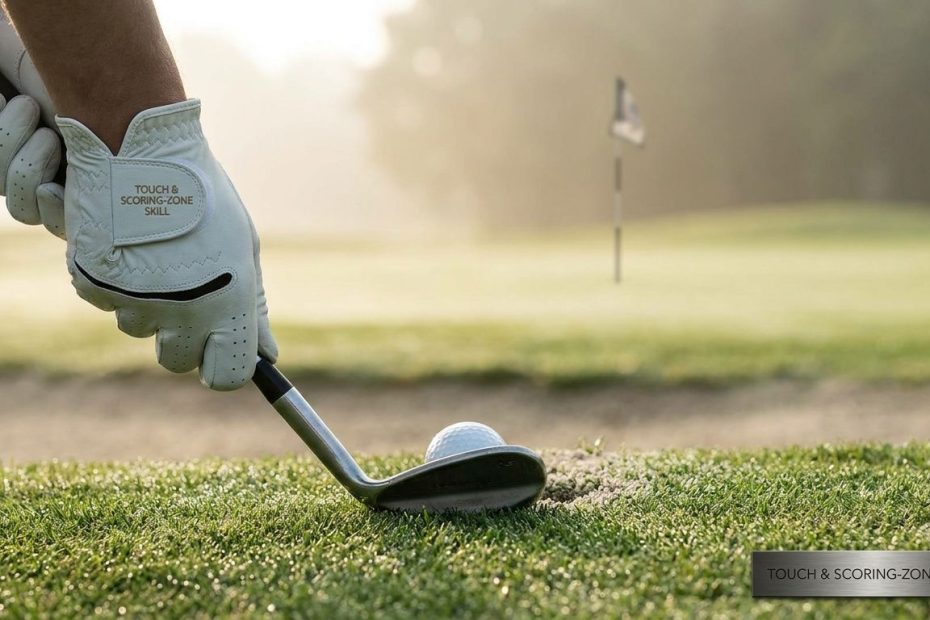
The short game still wins because golf scores are decided by the shots that rescue misses, control distance, and turn average ball-striking into lower numbers. Simulators and launch monitors help you train smarter, but they can’t recreate real turf, green speed, lie variety, or the pressure of getting the ball up and down.
Modern golf data doesn’t make chipping, pitching, wedge control, and putting less valuable. It shows you where strokes are leaking, and many of those leaks still appear inside the scoring zone. If you’re using indoor golf practice to lower your handicap, the goal is not to reject technology; it’s to use it without letting your touch fade.
Is The Short Game Still Important If You Practice On A Simulator?
Yes, the short game is still important if you practice on a simulator because the simulator can train distance patterns, but it can’t fully train turf response, green reading, or lie management. Your scorecard still rewards the player who misses in the right place, chips close, and avoids wasted putts.
A simulator is strong when you’re working on full swings, carry distance, launch conditions, and repeatable wedge numbers. It gives you feedback that most golfers never had years ago, especially on partial wedge carry distances. That matters when you’re trying to build a wedge matrix from 40, 50, 60, 70, 80, and 90 yards. The problem starts when you treat clean indoor feedback as the same thing as on-course skill.
On grass, the club meets slopes, grain, tight lies, rough, damp spots, sand, and uneven stances. A perfect mat strike can hide a low-point error that real turf would expose immediately. That’s why your indoor numbers may look tidy, yet the first chip from a muddy lie on the course comes out weak or runs too far. The short game still wins because it asks for judgment, not just measurement.
What Does Strokes Gained Really Say About The Short Game?
Strokes Gained data says the short game remains a major scoring separator, especially for golfers who lose shots around the green and from partial wedge range. Long shots matter, but poor wedge control and three-putts can erase good driving quickly.
Mark Broadie’s work on Strokes Gained showed that for Professional Golfers’ Association(PGA) Tour players, shots within 100 yards and putting account for a large share of the scoring gap between elite players and golfers who shoot around 90. That doesn’t mean you should ignore driving or approach play. It means you need to know where your own scoring loss sits. If you hit it far but need three shots to finish from beside the green, your scoring ceiling stays low.
Amateur data from Arccos and Shot Scope points to the same practical lesson. Golfers who score better tend to lose fewer strokes inside 50 yards, and separation between handicap levels often appears in the 25 to 50 yard range. Proximity from 50 to 75 yards has also been identified as a top scoring predictor for mid-handicap players. That range is awkward, which is exactly why it deserves more attention than a few rushed chips before your tee time.
Do Launch Monitors Help Your Wedge Game?
Yes, launch monitors can help your wedge game when you use them to measure carry distance, spin, launch, and consistency. They become less useful when you expect them to replace real lies, real greens, and real landing behavior.
A launch monitor can help you build reliable wedge stock shots. You can learn how far a half swing carries, how much a softer grip changes distance, and which wedge produces the best window for a 60-yard shot. That information is useful because many golfers guess from inside 100 yards. Guessing leads to long misses, short misses, and poor club choices.
Data works best as a calibration tool. Use the monitor to map your numbers, then test those numbers outdoors. If your 55-yard indoor shot carries the right distance but releases too much on a real green, the number is not the whole answer. The missing piece is how the ball lands, checks, rolls, and reacts after contact with the surface.
Why Can Indoor Practice Mislead Your Chipping And Pitching?
Indoor practice can mislead your chipping and pitching because mats remove much of the penalty for poor turf contact. They also change spin behavior, which can make a wedge shot look more controlled indoors than it plays outside.
TrackMan research notes that indoor hitting mats can reduce spin compared with real grass, and they don’t recreate bounce, grab, or friction from natural turf. That matters most on chips, pitches, and partial wedges where the strike is close to the ground. A small contact error can change launch, spin, and rollout. Indoors, the same motion may appear acceptable because the mat lets the club slide.
Lie variability is the other missing piece. A tight fairway lie asks for clean contact and precise low point. Rough asks you to predict how much grass gets between the face and the ball. Sand asks for splash control, entry point, and speed. No simulator mat gives you all of that feedback, so simulator-only practice can leave a gap between your numbers and your course skill.
Why Do Pros Still Spend So Much Time On Putting And Chipping?
Pros spend so much time on putting and chipping because their scoring depends on converting small advantages into saved strokes. Data helps them choose better targets, but skill around the green lets them recover when the full swing misses.
The best players don’t treat short game practice as casual warmup. They train landing spots, spin windows, release patterns, bunker distances, and putt speed. A tour-level player knows the difference between a wedge that lands soft and one that lands hot. That detail matters when the pin is close to an edge or the green slopes away.
Professional players also understand that golf is a miss-management game. You won’t hit every green. You won’t hit every approach to 12 feet. When you miss, your ability to leave a simple putt changes the hole. The short game still wins in those moments because one clean chip can protect the work you did from the tee.
Can You Improve Your Short Game With A Simulator?
Yes, you can improve your short game with a simulator if you use it for distance control, wedge mapping, start line, and repeatable strike patterns. You still need outdoor practice to train feel, green reaction, and decision-making.
Start by building a partial wedge chart. Hit controlled shots with each wedge using three swing lengths, then record average carry distances. Don’t chase your longest result. Use the number you can repeat. That gives you a practical scoring tool when you face 45, 60, or 75 yards on the course.
You can also run ladder drills indoors. Pick a carry number, then move up or down in small increments without changing clubs. This trains speed control and helps you avoid the common mistake of swinging hard with a high-lofted wedge when a softer lower-lofted shot would be easier. The simulator gives you the carry data; the course teaches you how that carry turns into stopping distance.
How Should You Practice Short Game If You Only Have A Simulator?
If you only have a simulator, practice short game by training predictable carry distances, clean contact, and pressure routines, then add small doses of real green work whenever possible. Even brief outdoor putting and chipping sessions can protect your touch.
Use your indoor sessions for measurable skills. Hit ten balls to a 30-yard carry, then ten to 40, then ten to 50. Track your average miss, not just your best shot. If most misses are short, you need better speed commitment. If they scatter left and right, start line and face control need attention.
For putting, don’t rely only on simulator make rates. Train start line with a gate, distance control with marked zones, and routine consistency with one ball at a time. Real greens add speed, slope, and surface variation, so indoor putting should sharpen stroke control rather than pretend to replace green reading. A useful split is simulator work for mechanics and carry control, grass practice for touch and judgment.
Are Simulators Making Golfers Worse At Chipping And Pitching?
Simulators don’t make golfers worse by themselves; simulator-only habits can. If you spend all your practice time on clean mats and perfect lies, your feel and adaptability can fade when you return to the course.
A Golf Digest instructor survey found that many teachers believe simulator-only practice can weaken short-game feel and creativity. That concern makes sense. Indoor practice rewards repetition under controlled conditions. Course scoring rewards adjustment under imperfect conditions.
You can prevent that problem by changing what you expect from the simulator. Use it to build baseline wedge distances, learn your strike tendencies, and test carry control under pressure. Then use real grass to answer the questions the simulator can’t answer: how the club moves through the lie, how the ball releases, and how your landing spot choice changes with slope. Technology should sharpen your plan, not become your only teacher.
What Should You Measure In The Scoring Zone?
You should measure carry distance, proximity, strike quality, rollout pattern, up-and-down rate, and three-putt avoidance in the scoring zone. Those numbers tell you whether your short game practice is lowering scores or just creating tidy simulator sessions.
Carry distance is the best starting point. If you don’t know how far your partial wedges fly, every short approach becomes a guess. Proximity gives you the next layer because a 50-yard shot to 30 feet is very different from a 50-yard shot to 12 feet. A launch monitor can help with the first number, and on-course tracking can show whether the number helps you score.
Putting deserves the same attention. Arccos data shows a large gap between higher-handicap players and scratch golfers in three-putt frequency. That’s not only a putting stroke issue. It’s often a speed-control issue, a lag-putting issue, and an approach proximity issue. If you reduce three-putts and improve wedge proximity, you give yourself a cleaner path to breaking 90, breaking 80, or protecting a strong round.
Do You Lose Short Game Feel Using A Golf Simulator?
- Yes, if it replaces grass practice.
- Mats change spin and turf feedback.
- Simulator putting misses real slope and speed.
- Add real green work to keep touch.
Make The Scoring Zone Your Best Edge
The short game still wins because scoring is built from recovery, control, and fewer wasted strokes near the hole. Simulators and data give you useful feedback, especially for wedge carry numbers and repeatable practice, but they can’t train every lie, every green, or every reaction after the ball lands. Use technology to measure your patterns, then use real-course practice to test your touch. If your goal is lower scores, invest time inside 100 yards, track the results that matter, and don’t let clean indoor contact fool you into thinking the work is finished.
References:
- Mark Broadie, Every Shot Counts
- Professional Golfers’ Association Tour Statistics
- Arccos Golf Data And White Papers
- Shot Scope Performance Data
- TrackMan University
- DECADE Golf
- Golf Digest Instruction
- Science And Motion PuttLab
- MyGolfSpy Testing

Barry Bekkedam is an entrepreneur and finance executive focused on investment management and advisory. A former Villanova standout and member of Canada’s men’s national basketball team, he now leads ventures in asset management and philanthropy, including the Barry Bekkedam Foundation supporting education and community development.